Examples
All examples on GitHub —
examples/(clone, run, modify)
Runnable example scripts and notebooks live in the examples/ directory of
the repository. The notebooks under docs/notebooks/ (cards below)
are cell-by-cell tutorials and the easiest entry point. Scripts for
workflows that don't fit a notebook (e.g. multi-process multi-GPU FWI) are
linked at the bottom of this page.
Notebooks (start here)
-
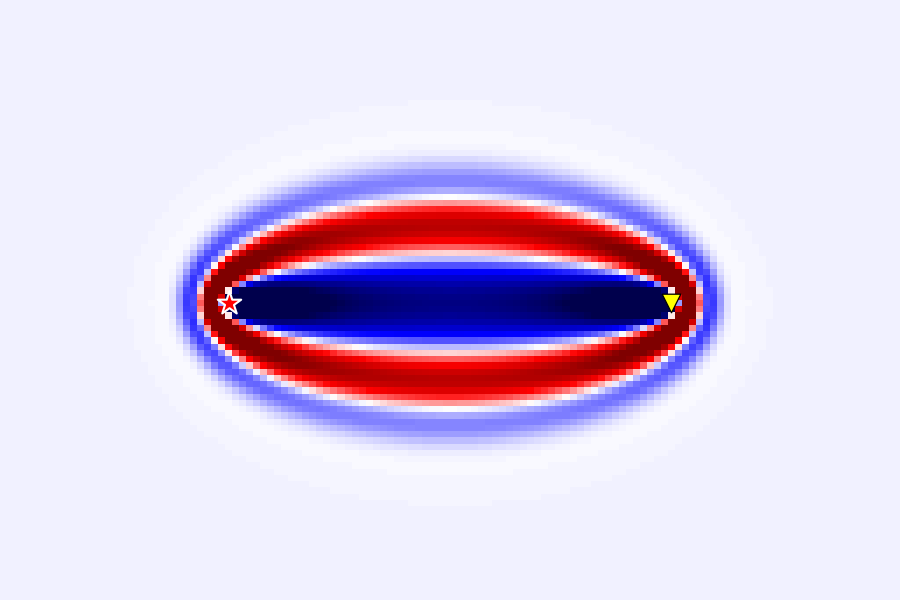
Hello · SWEEP
Smallest end-to-end SWEEP story in one notebook: parameters → model →
Acoustic()+PropTorch()→ one shot gather → one.backward()for a vp gradient → 5-line Adam loop. No external data. -
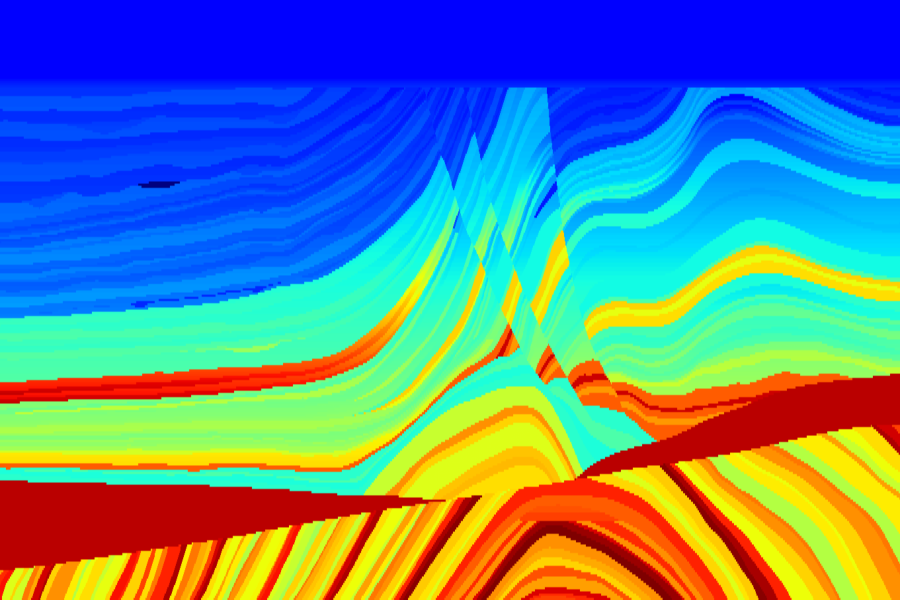
FWI · Acoustic · Marmousi
Load Marmousi from
sweep.datasets, build a 192×320 window, forward-model observed gathers, and invert the smooth start with Adam + MSE. Each phase is one cell. -
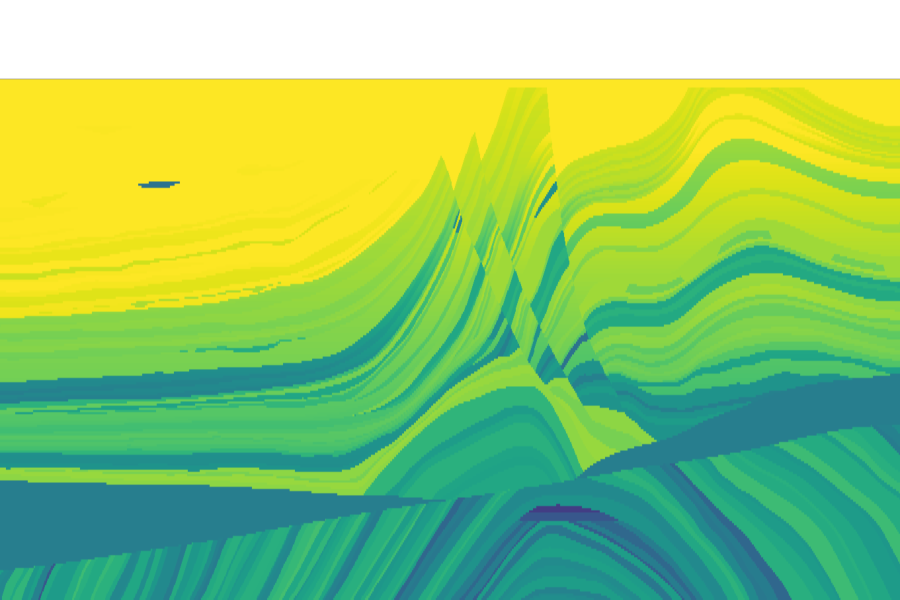
FWI · Elastic · Marmousi
Same skeleton, but the equation is
Elasticand the model is the(vp, vs, rho)triplet.vsandrhoare derived fromvpwith Poisson + Gardner relations so the example still runs with zero downloads. -
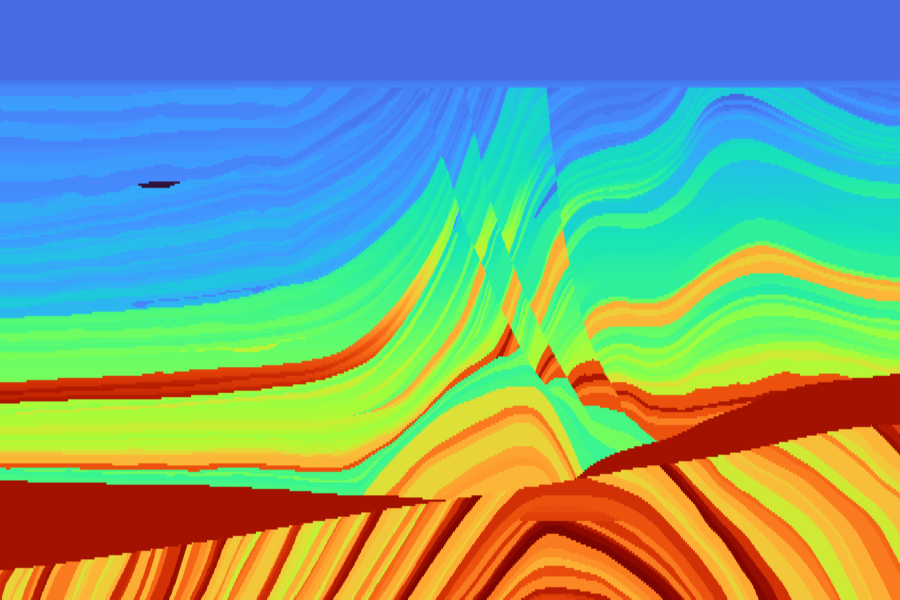
FWI · multiscale
Three-band frequency progression (3 → 6 → 12 Hz) of acoustic FWI on Marmousi 25 m. Each band feeds its final model into the next; loss drops monotonically across the chain and avoids cycle skipping.
-
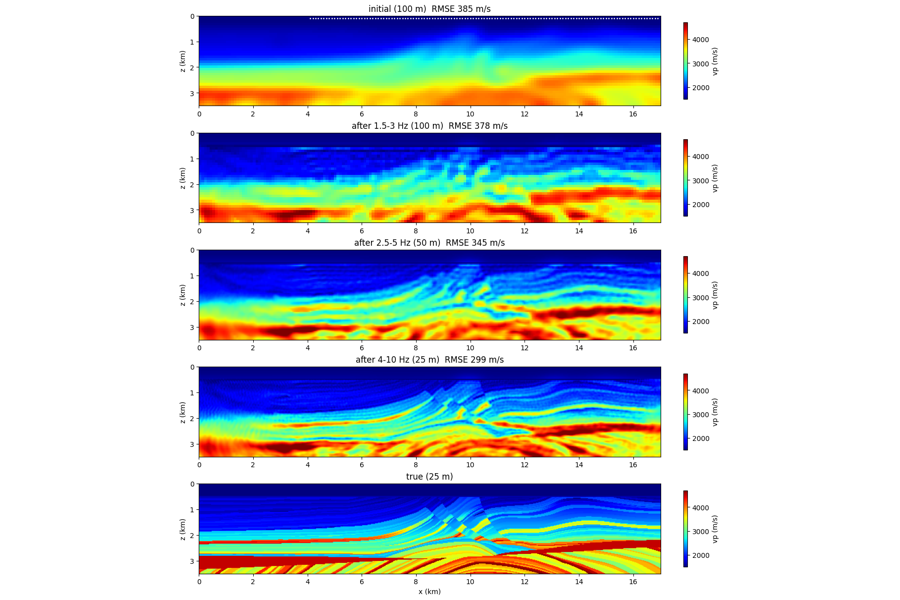
FWI · Frequency-selection encoding
A towed-streamer survey, 129 shots every 100 m, all in one forward: each shot radiates its own monochromatic frequency, the steady-window DFT separates them with zero crosstalk, and a coherence misfit cancels the wavelet. Multiscale 1.5–3 / 2.5–5 / 4–10 Hz, each band on its own grid and time step (100 / 50 / 25 m), in plain torch on Marmousi.
-
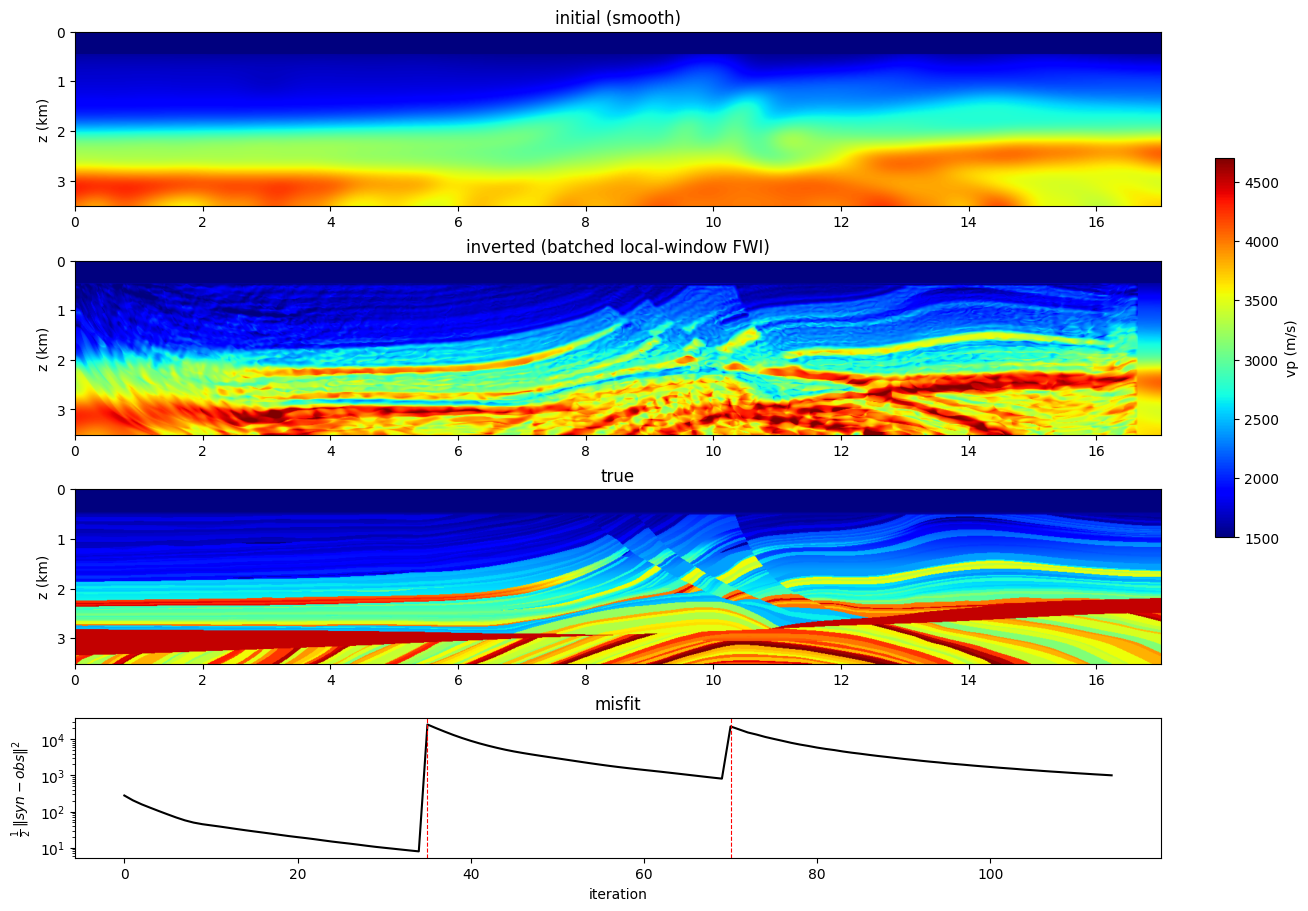
FWI · Batched per-shot local windows
A fixed streamer makes every shot's model window the same width, so all the crops stack into one batched solver call and the overlapping windows scatter-add back onto the full model through autograd. Frequency continuation recovers Marmousi from a smooth start on one GPU.
-
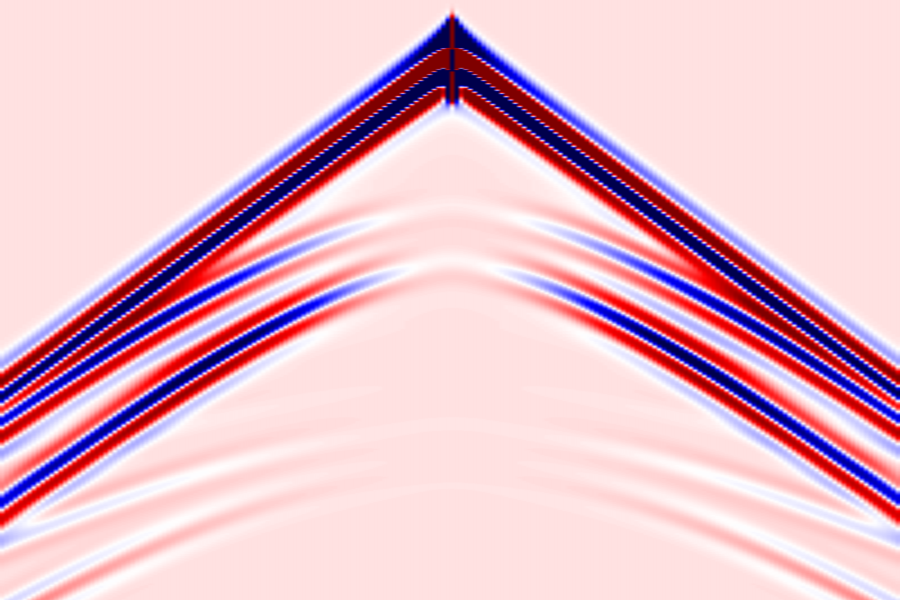
DAS · Zhao vs Mu
Forward-model the same three-layer elastic medium with the two DAS formulations and compare the resulting strain-rate gathers side by side.
-
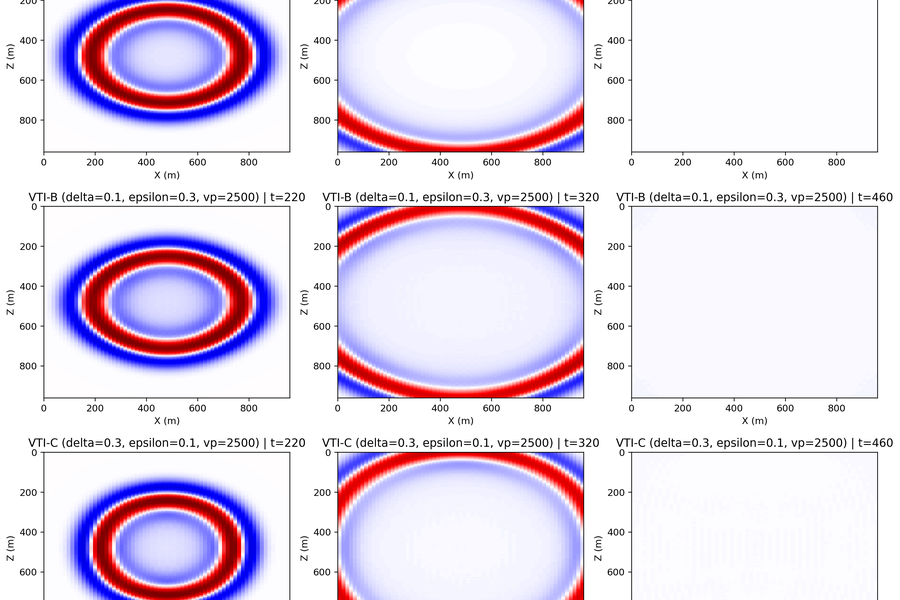
Wavefield · VTI + shear suppression
Run Duveneck (1st-order), Liang (2nd-order pseudo-acoustic), and Alkhalifah (η-acoustic) through the unified
AcousticAnisofactory on the canonical Duveneck Fig 2 setup; the trailing cell demonstrates the δ→ε disk taper that kills the pseudo-acoustic shear artefact. -
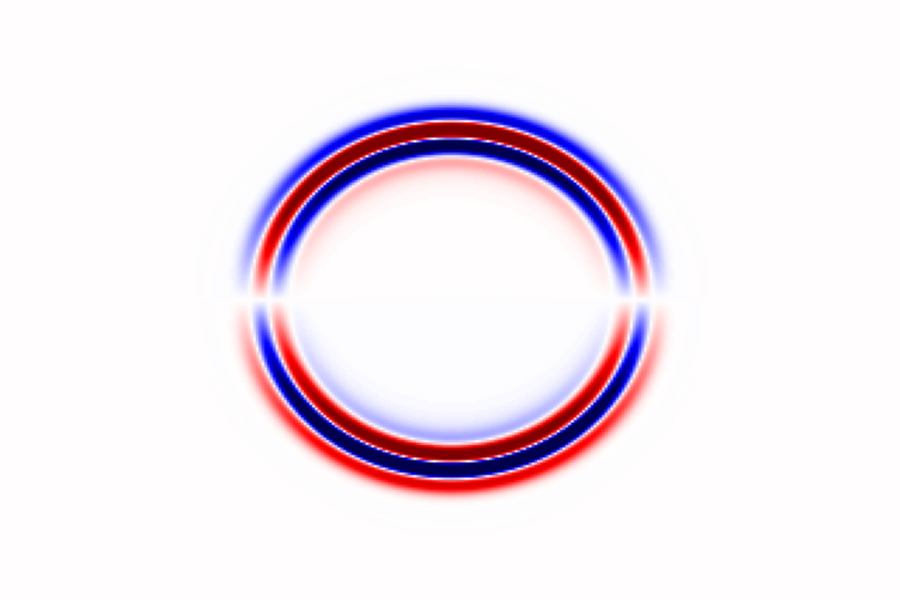
Wavefield · Elastic
Wavefield snapshots from three different stress-source loadings on a uniform elastic medium — explosion, vertical dipole, and pure shear — to visualize P/S excitation and radiation patterns.
-
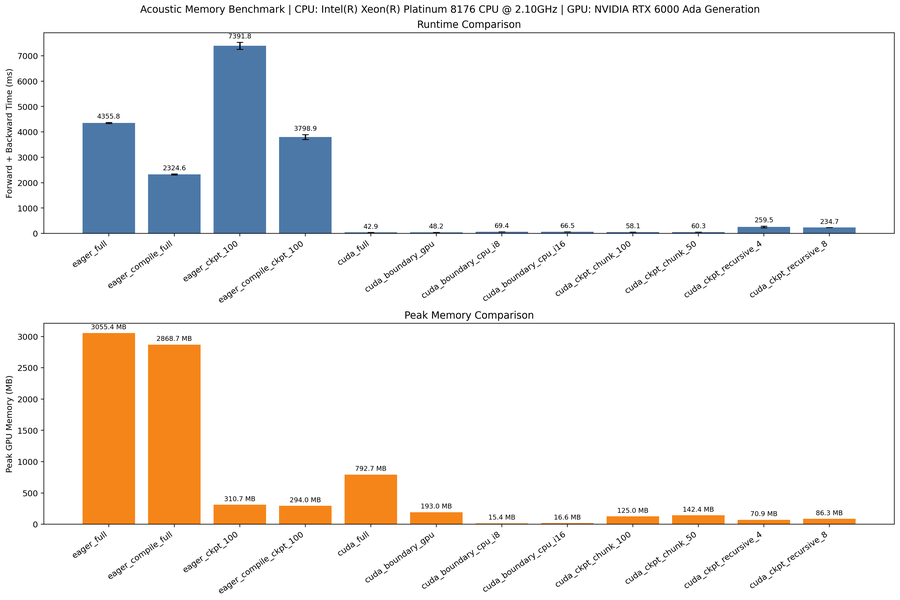
Memory · strategies
Same forward + backward step run under every memory strategy (eager full / chunk-ckpt / boundary-saving on gpu × dtype vs. c full / boundary-saving on
{gpu, cpu, disk}× dtype / chunk-ckpt / recursive-ckpt) with side-by-side peak-memory and wallclock charts. -
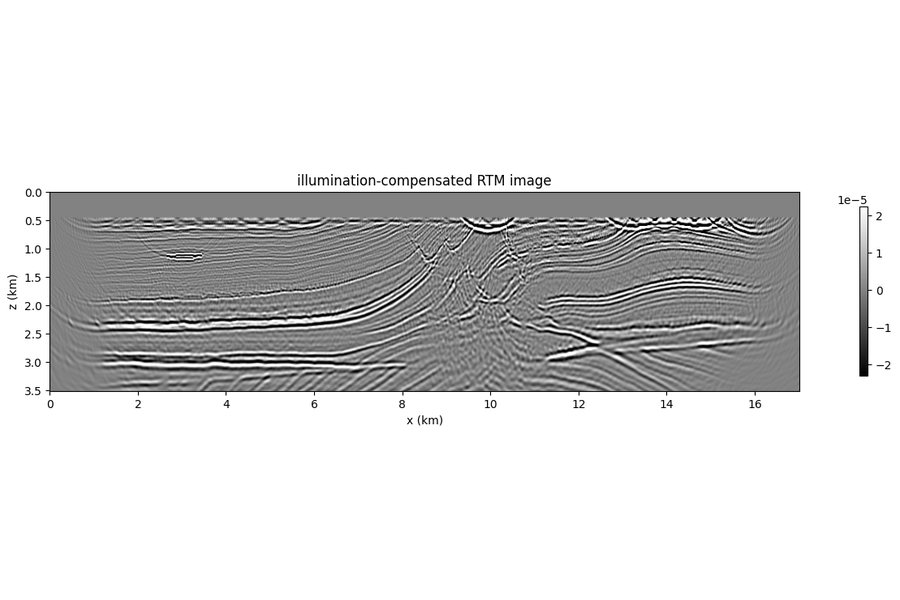
RTM · Acoustic · Marmousi
Reverse-time migration on full 12.5 m Marmousi with a 15 Hz Ricker — the RTM image as the gradient of an inner-product loss through the boundary-saving backward, with background subtraction, near-offset mask and illumination compensation. A clean reflectivity image in <3 s on 30 shots.
-
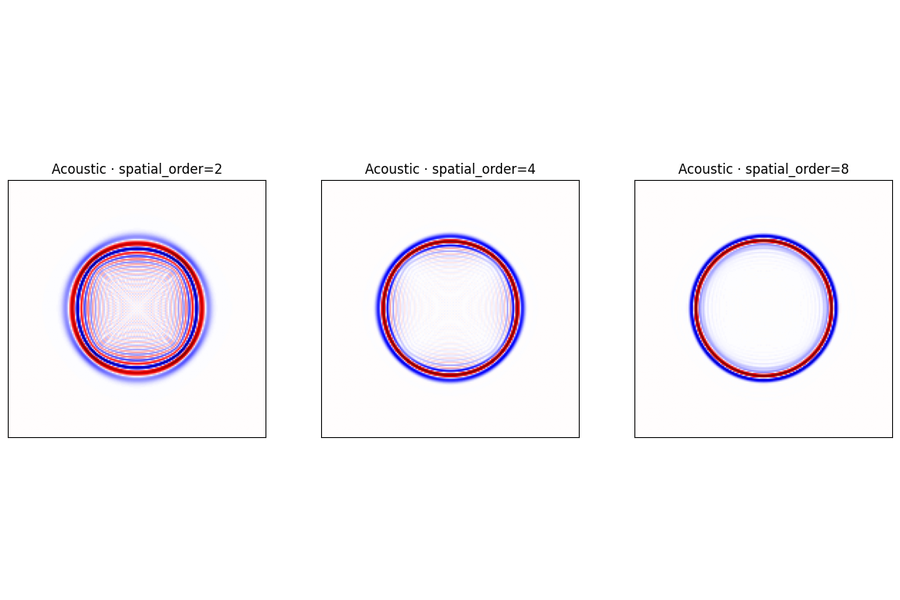
Solver · hyperparameters
Side-by-side wavefield snapshots showing how the propagator's
spatial_order,abcn(PML width) andpml_typechoices visibly change boundary reflections and grid dispersion on a single shot. -
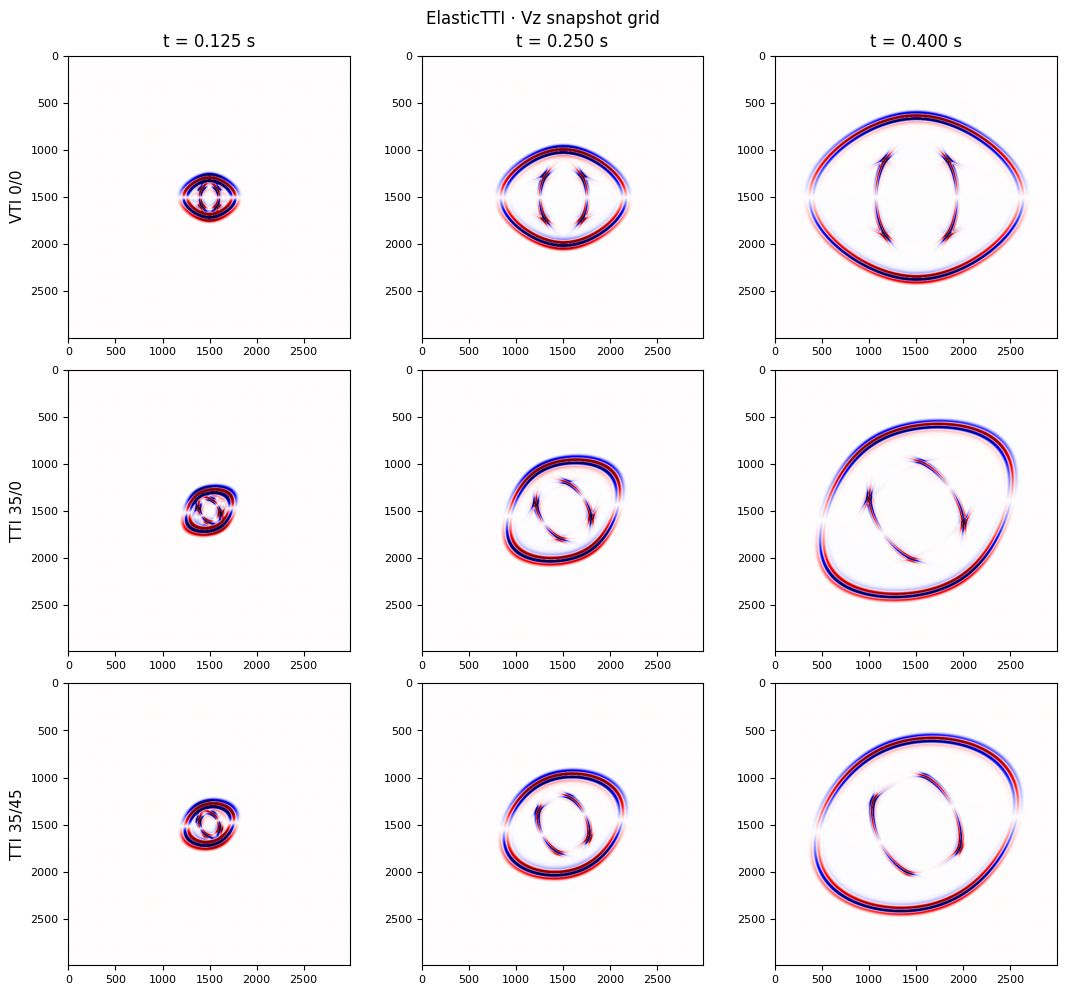
Wavefield · Elastic TTI
Rotated staggered-grid (
ElasticTTI)vzsnapshots across three tilt / azimuth cases — the Duveneck Fig 2 setup at full resolution with(ε, δ, γ, θ, φ)rotated symmetry axis. -
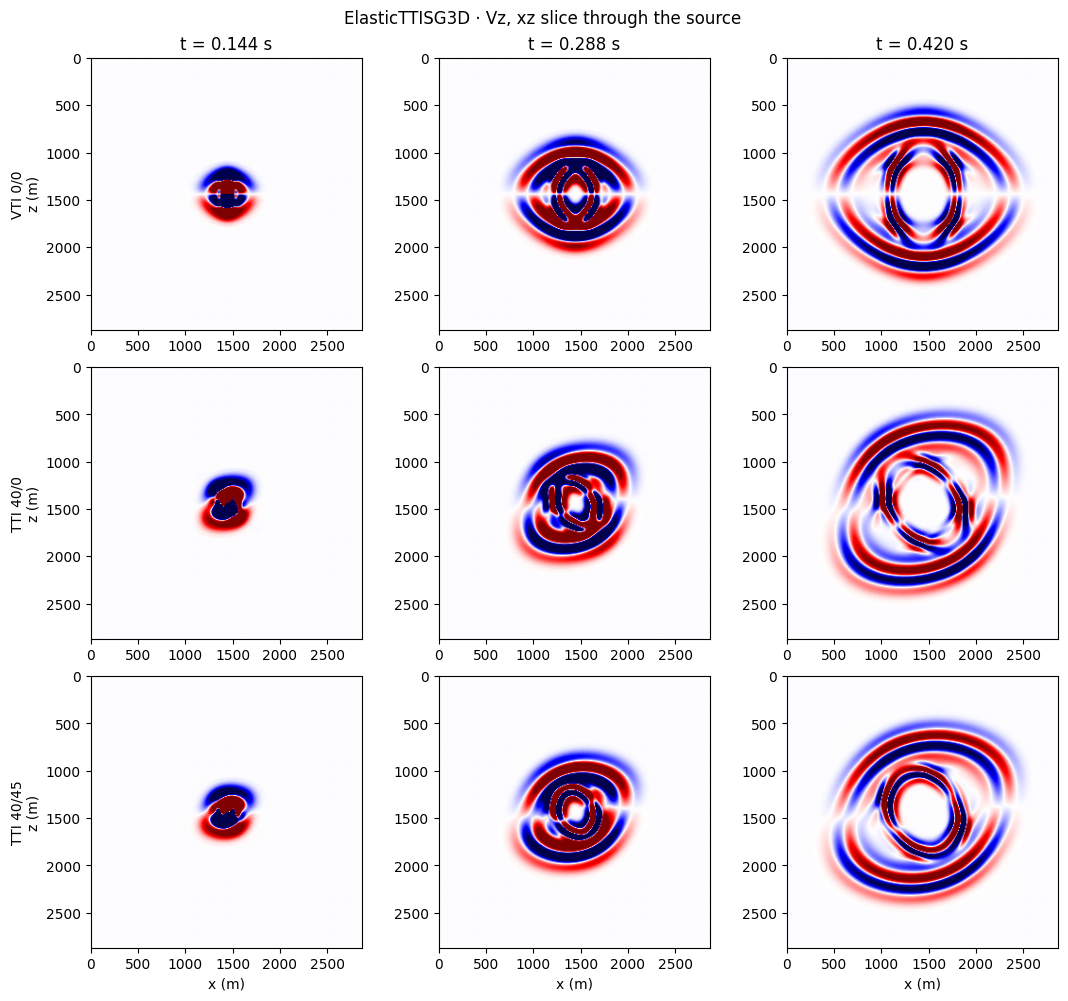
Wavefield · Elastic TTI · 3-D
ElasticTTISG3Don a 2.88 km cube:vzthrough the source plane for a VTI reference and two rotated axes. In 3-D the azimuth stops being decorative — at φ = 45° the qP front leaves the x–z plane, which no 2-D run can show. -
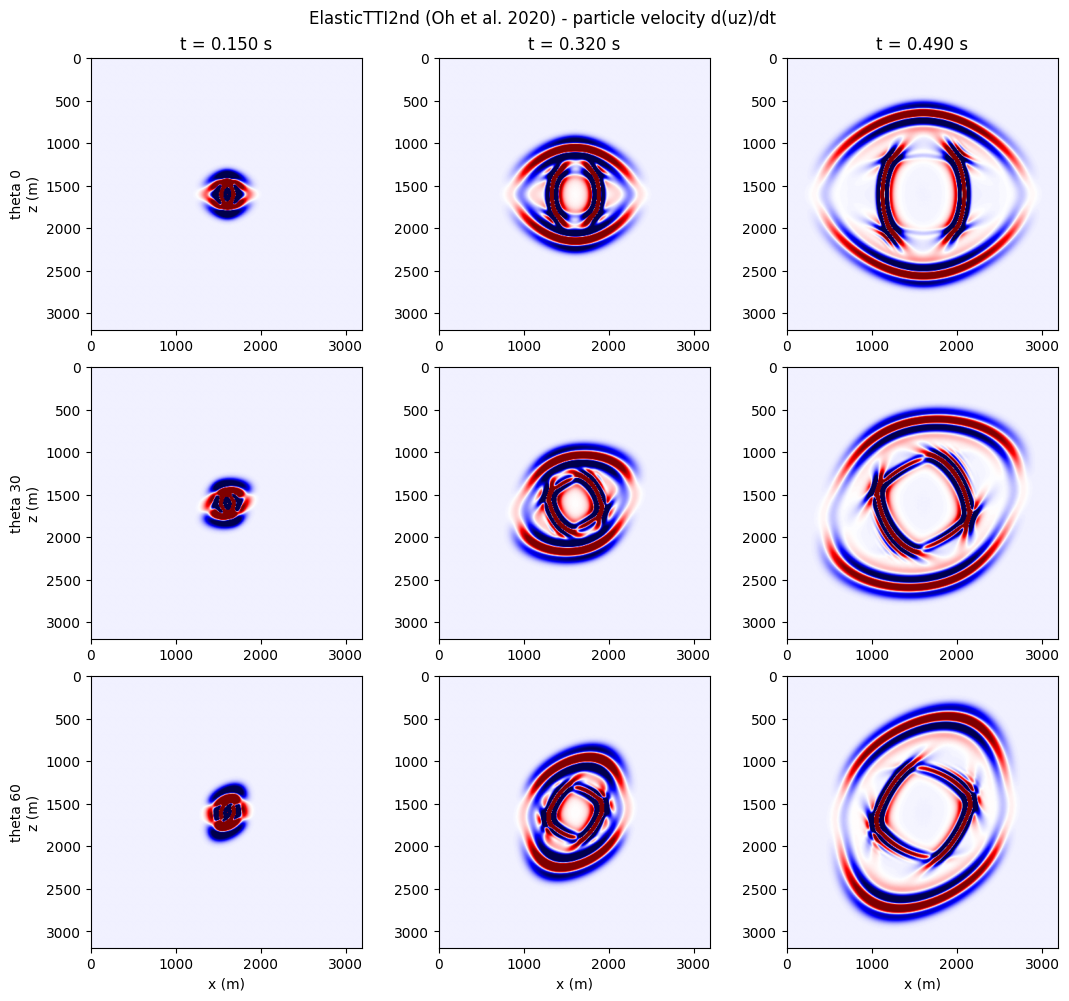
Wavefield · Elastic TTI · displacement (Oh 2020)
ElasticTTI2nd: two displacements on a triple time buffer instead of three velocities and five stresses, with the hierarchical(vh, η)parametrisation of Oh et al. 2020. Three tilts, cross-checked againstElasticTTISGon the qP wavefront. -
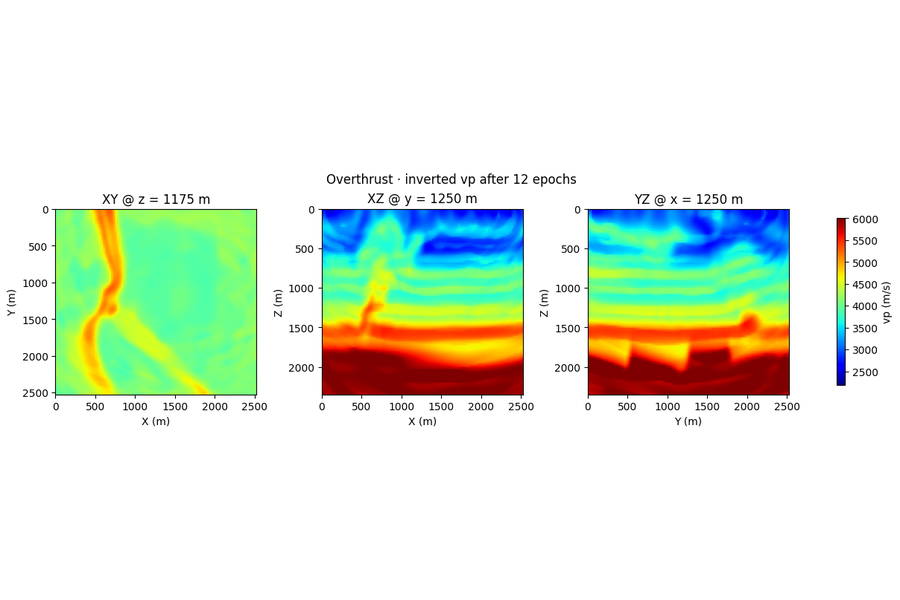
FWI · 3-D · Overthrust
Acoustic FWI on a 3-D Overthrust volume —
Acoustic3Dsolver onimpl='eager', chunked checkpointing for memory, depth/inline/crossline slices of the recoveredvpcube vs ground truth. -
Multi-GPU · DDP vs 1 GPU
torchrun --nproc_per_node=Ndriver that shards shots across GPUs and syncs gradients viatorch.distributed, timed against a single-GPU baseline on a two-layer toy model (the saved run: 3.53× on 4 GPUs). -
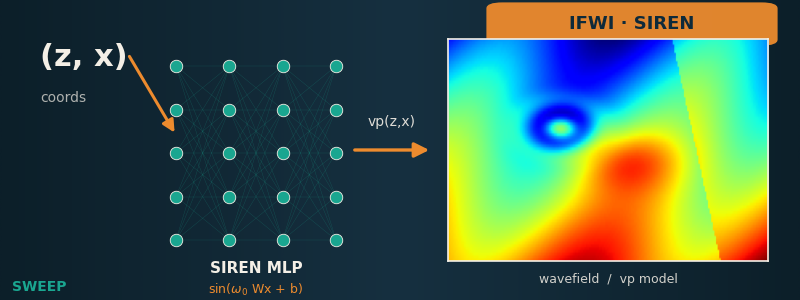
IFWI · SIREN coordinate network
Implicit FWI: a SIREN coordinate network outputs
vp(x, z)instead of a grid of free parameters; its weights are inverted by backprop through the propagator on Marmousi. -
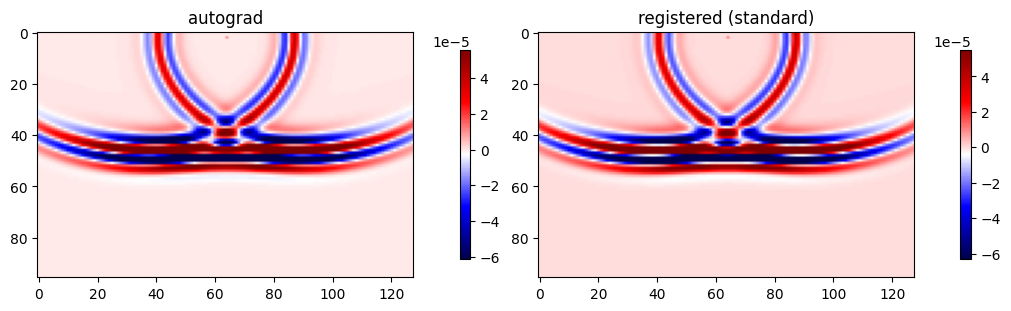
Custom gradients · imaging condition
Register your own imaging condition — override the default correlation with a user-defined gradient kernel via the autograd hook and compare it to the built-in one.
-
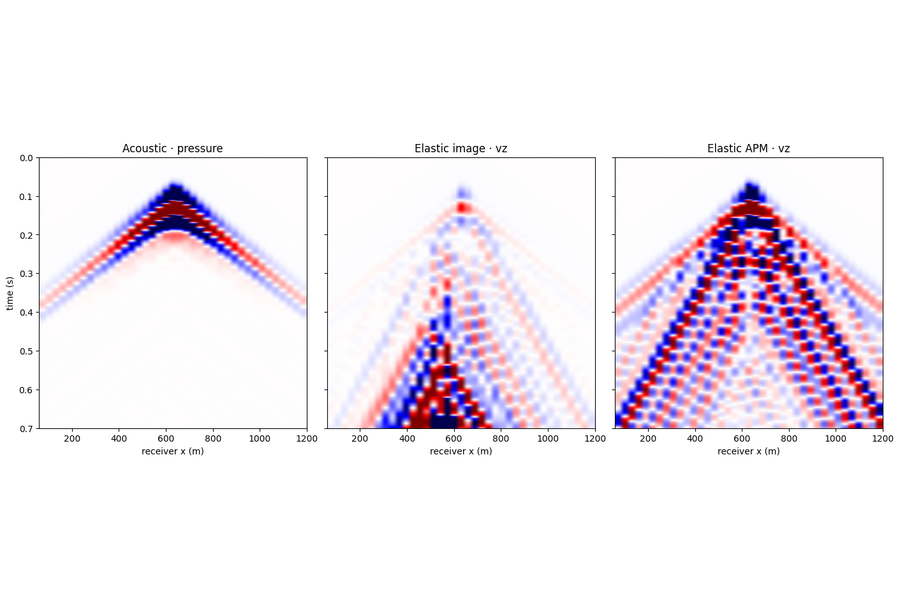
Wavefield · irregular topography
Image-method irregular free-surface for acoustic & elastic 2-D — drape a non-flat surface along the top of the model and see how the topography reshapes the surface waves and primaries.
-
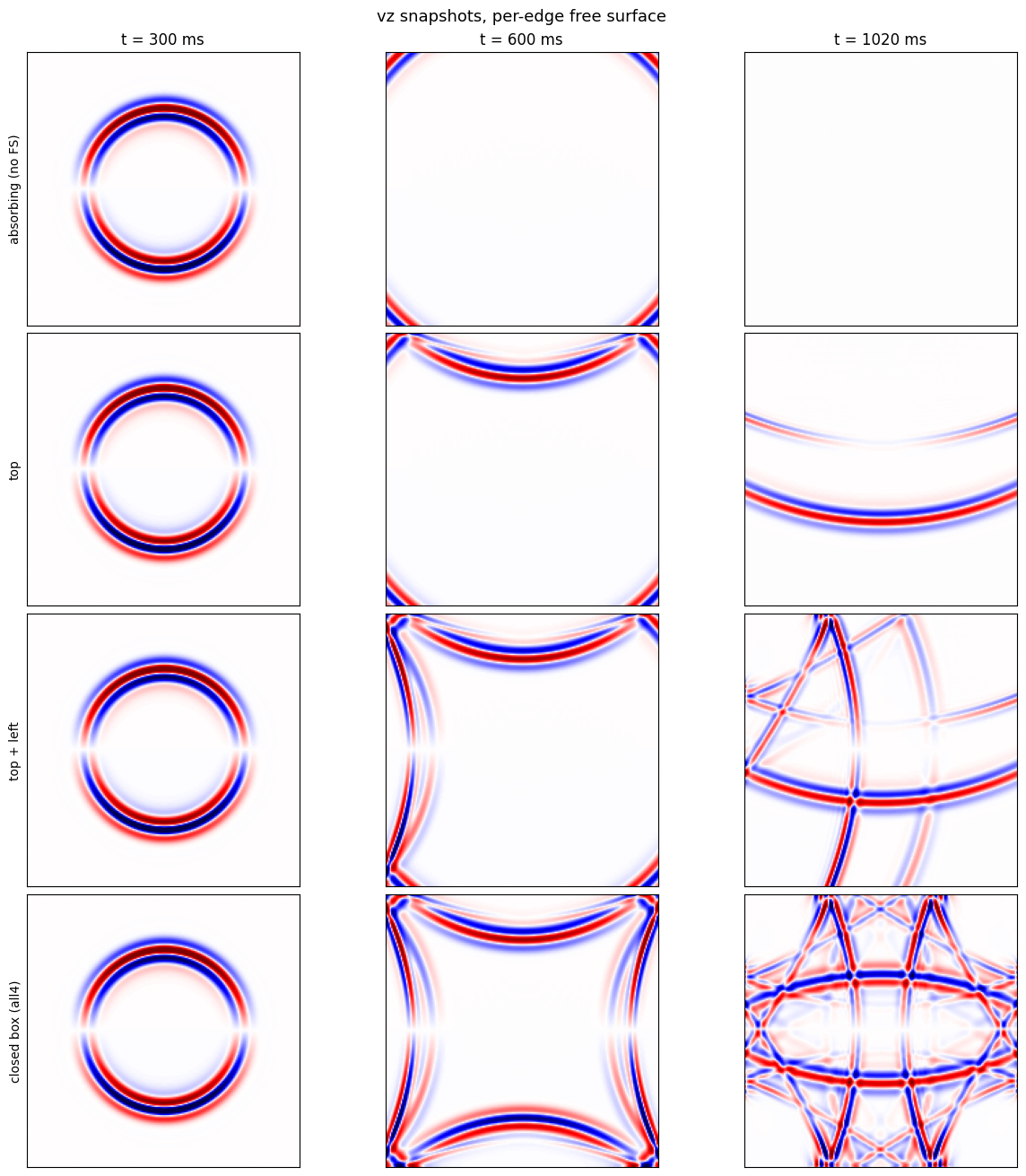
Wavefield · Per-edge free surface
free_surfacetakes a list of faces, not just a bool: free surface on any subset of the four edges — top-only, two-face corners, or a fully closed reverberant box (deepwave-style) — with gradients on every backward memory mode. -
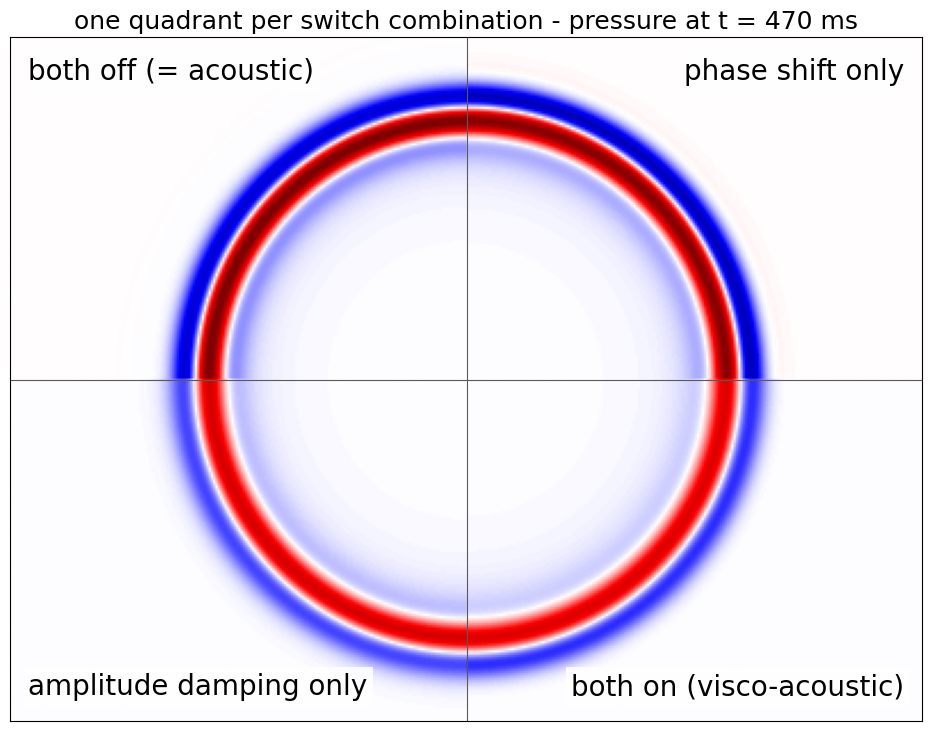
Wavefield · Visco-acoustic · constant-Q
ViscoAcoustic: the acoustic solver plus Zhu & Harris (2014) decoupled attenuation — a dispersion switch that moves the front and a damping switch that decays it, each demonstrated alone, with the measured decay checked against constant-Q theory. -
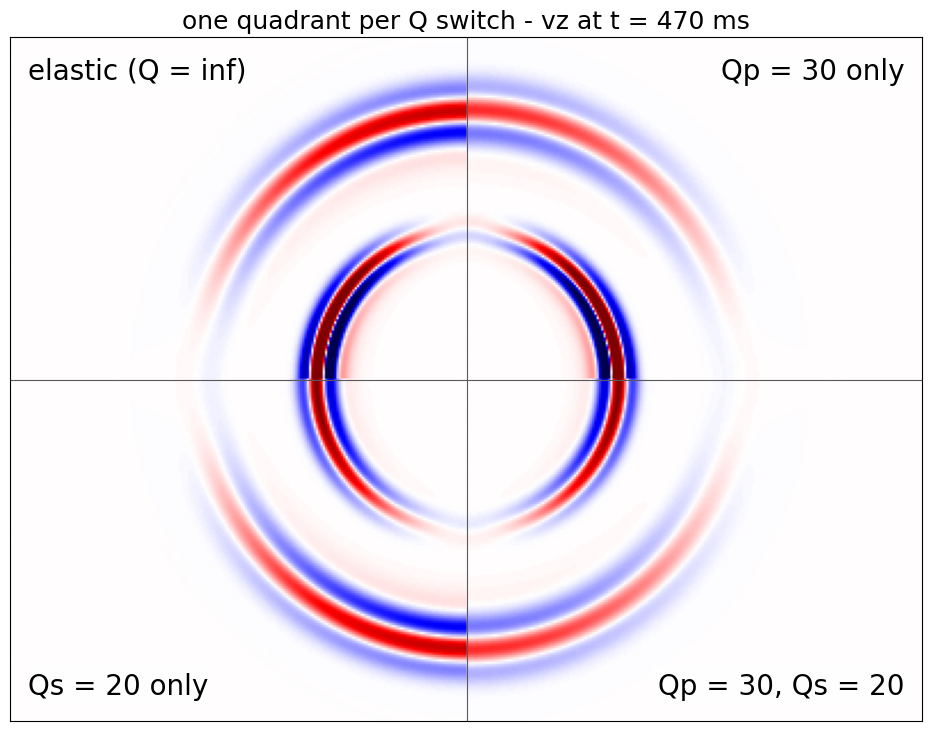
Wavefield · Visco-elastic · GSLS
ViscoElastic: the elastic solver plus the generalized standard linear solid SPECFEM2D uses —QpandQsswitched independently, one quadrant per combination, the P/S decay checked against constant-Q theory, and why dispersion and attenuation cannot be switched apart. -
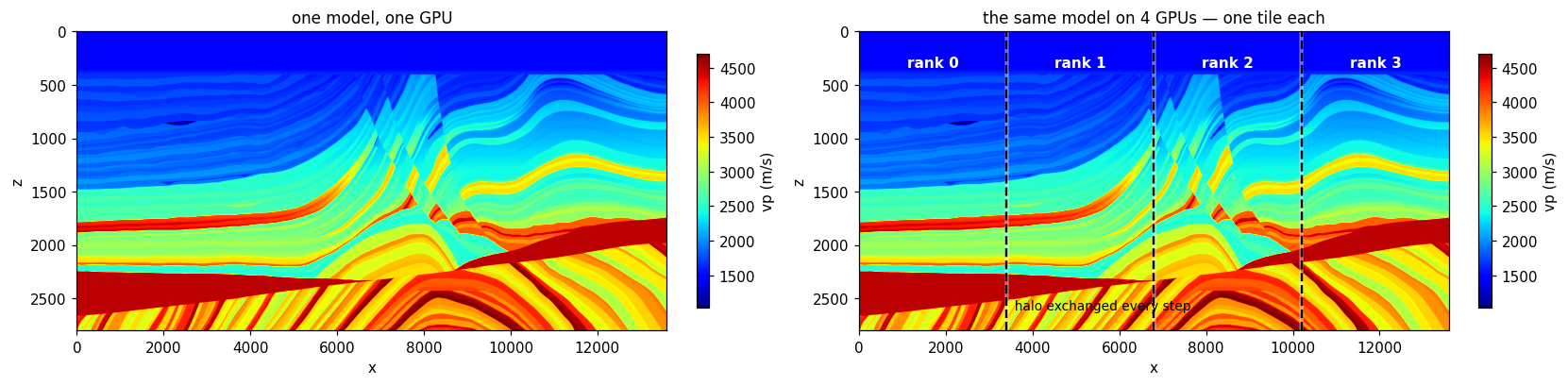
HPC · Domain decomposition
One model, several GPUs:
ModelParallelslices it into tiles and exchanges a halo every step, so a single shot is solved cooperatively rather than replicated. Gradients are bit-identical to the single-domain run — the notebook checks that, tile by tile. -
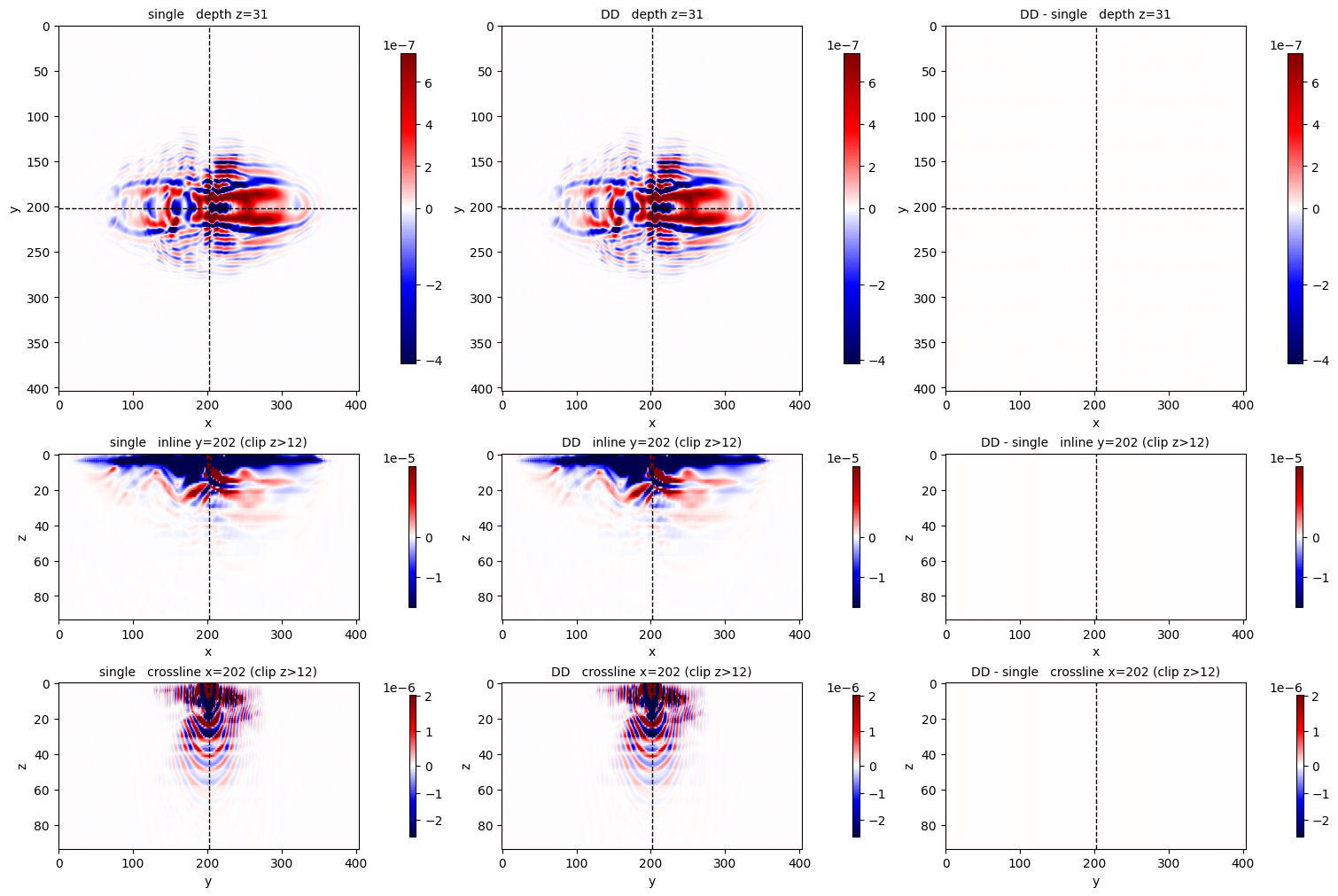
HPC · DD on Overthrust 3-D
The same split on a real 3-D benchmark, 2 × 2 tiles across four GPUs. The gradient is sliced three ways straight across the cut planes, where a halo bug would show as a stripe — and compared against the single-GPU answer.
-
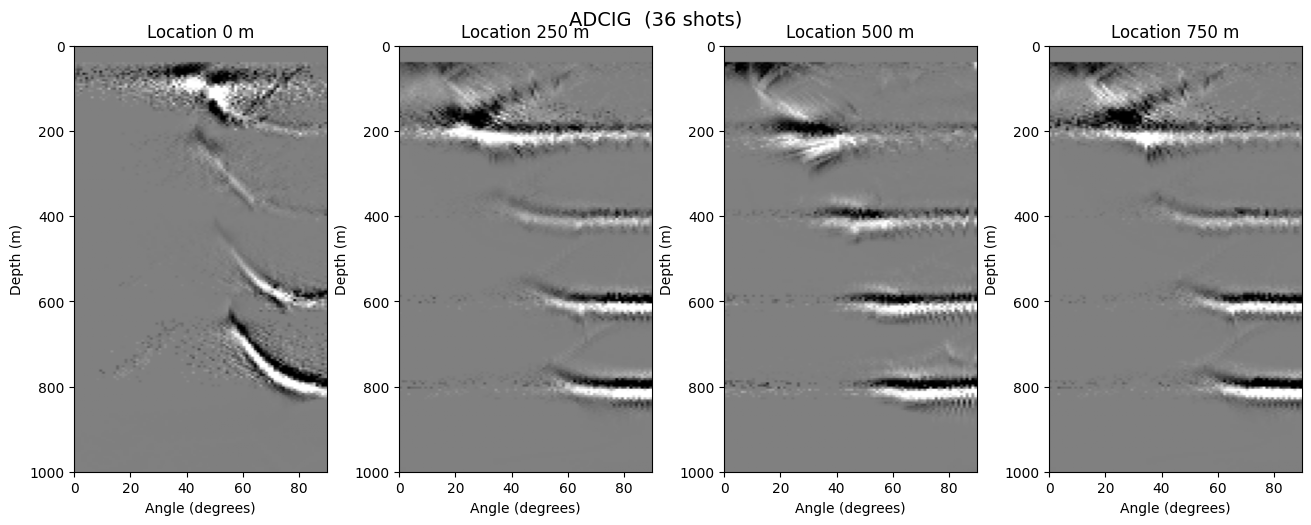
ADCIG · Poynting (custom backward)
Angle-domain common-image gathers via a custom imaging condition plugged into the eager backward with
register_gradient— Poynting-vector recipe. For the space-lag ADCIG (2D + 3D, CUDAcompute_adcig) see the next card. -
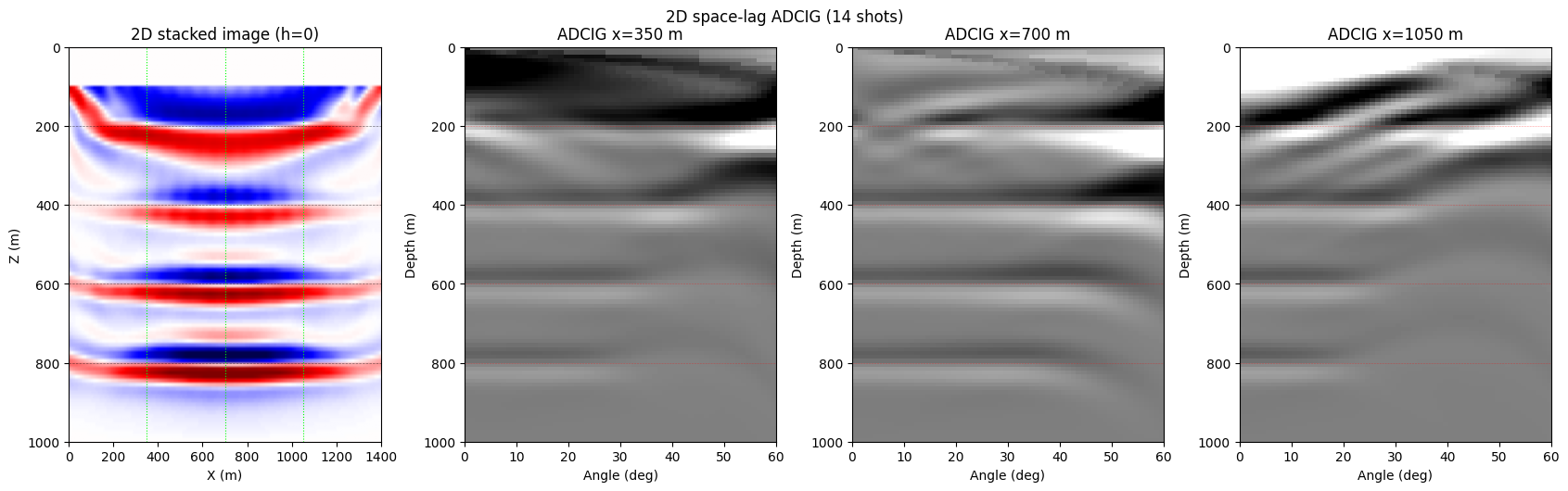
ADCIG · space-lag (2D & 3D)
Subsurface-offset extended imaging condition (Sava & Fomel) via the built-in CUDA
compute_adcigtoggle, then slant-stack to angle. Boundary-saving path, acoustic 2D & 3D. -
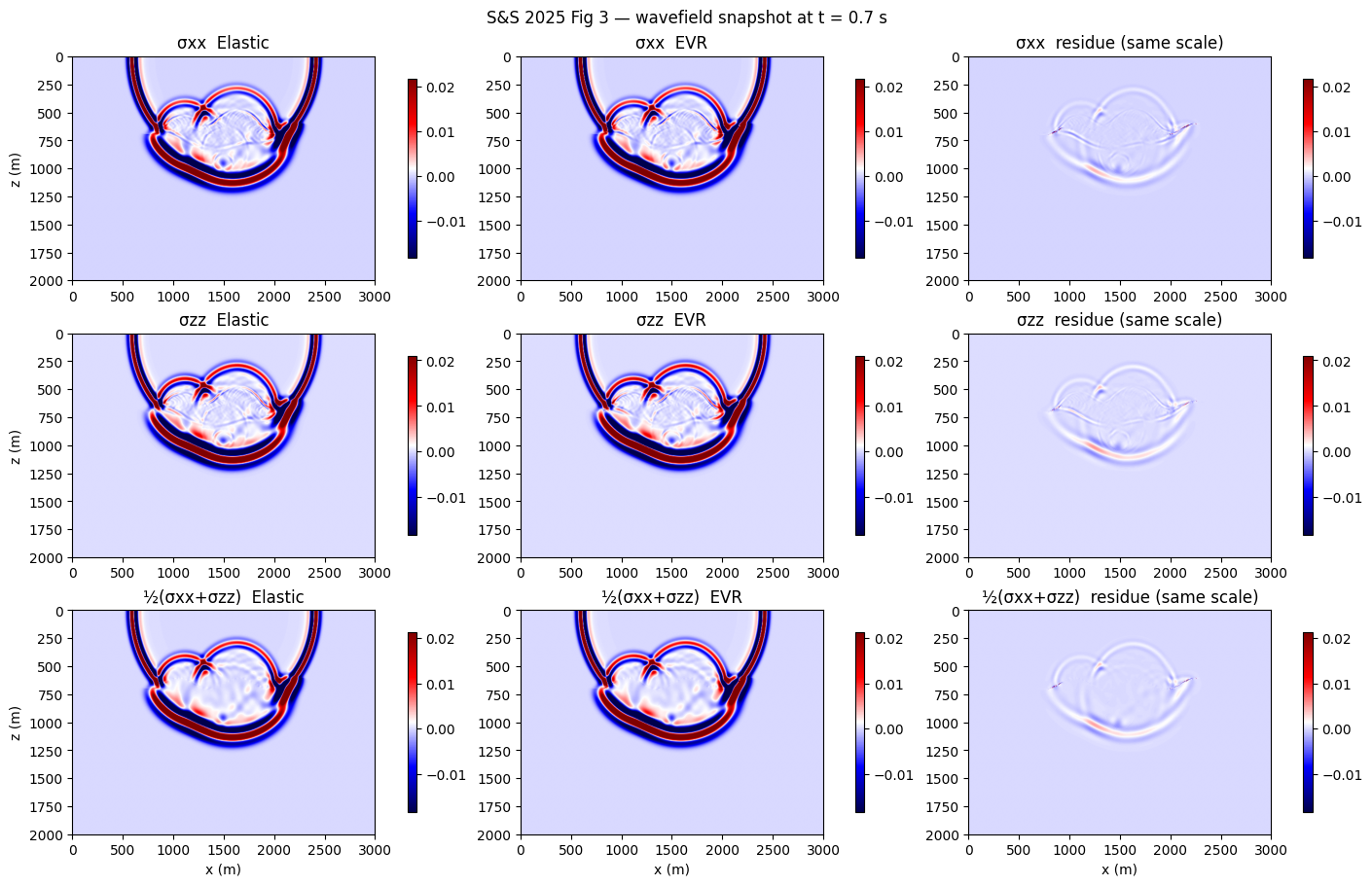
Elastic vector reflectivity
Forward-modeling validation of elastic vector-reflectivity (Soares & Sacchi 2025) — the formulation reproduced and checked against the reference.
-
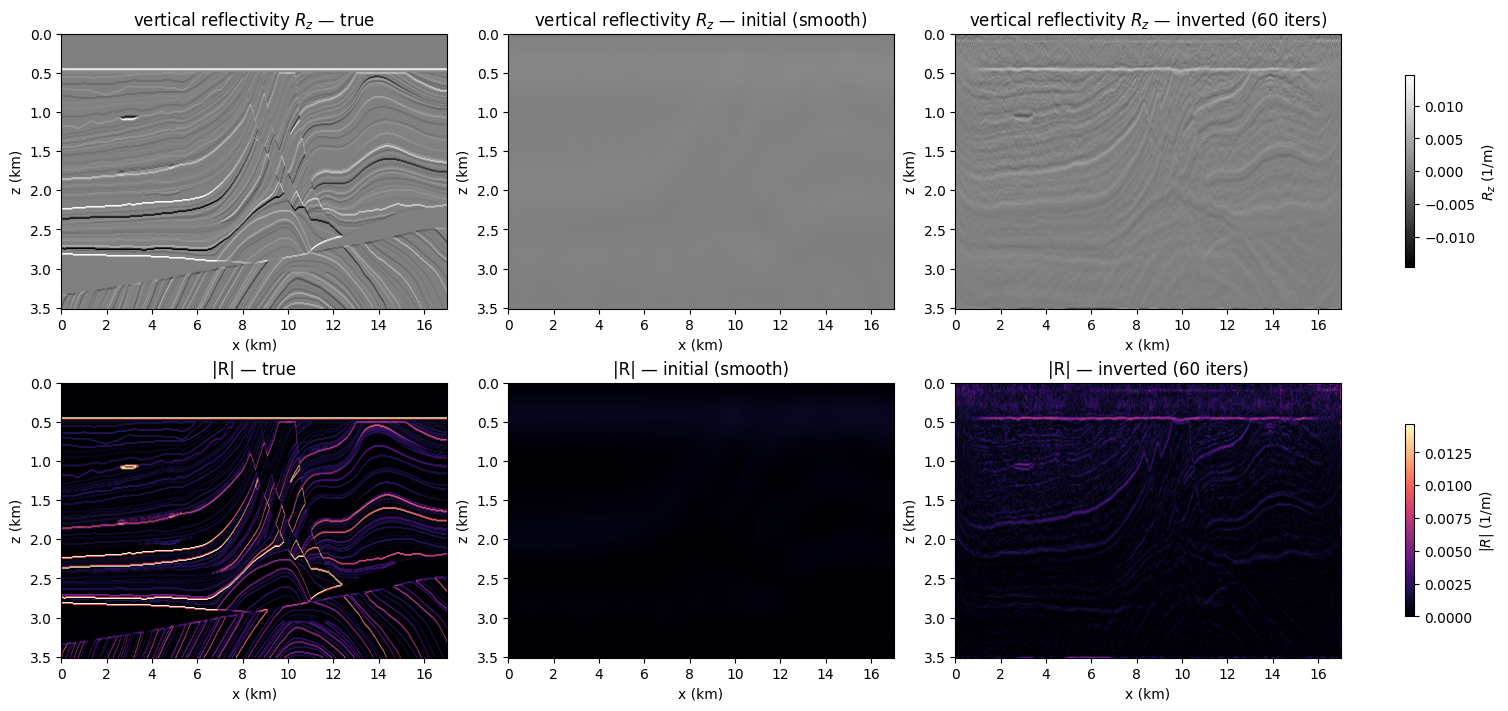
FWI · VRZ · Marmousi
Acoustic variable-density (VRZ) FWI on Marmousi — vector reflectivity from impedance, inverted with the
AcousticVRZequation. -
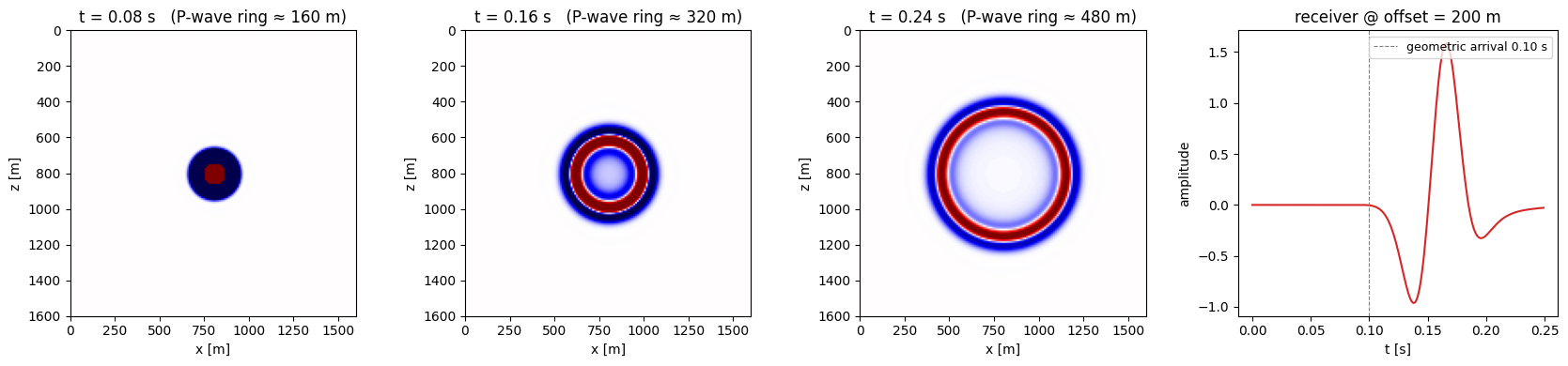
Extending · add a new equation
Tutorial: add a brand-new wave equation to SWEEP — define its fields and time step, register it, and drive it through
PropTorchlike any built-in. -
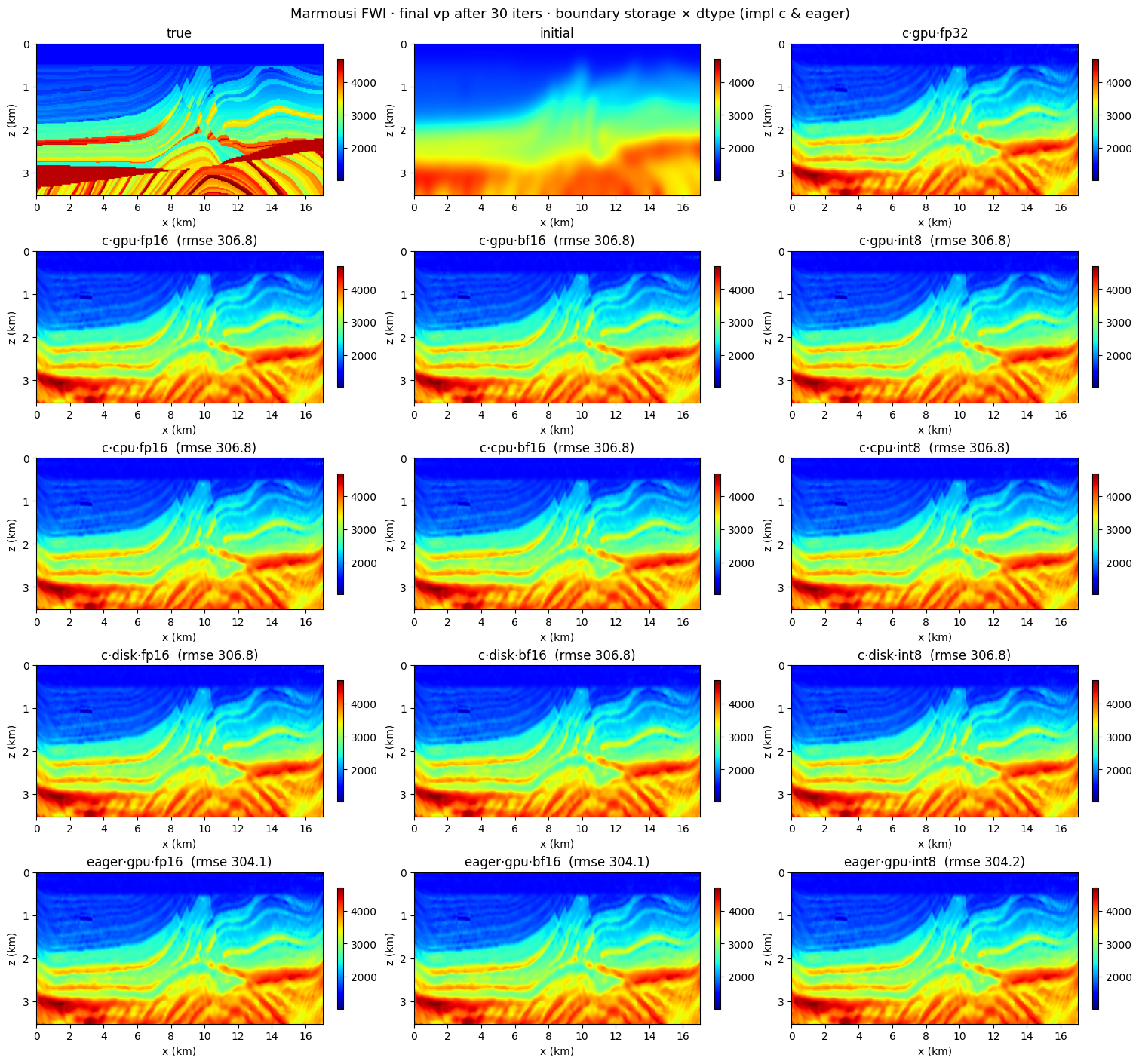
FWI · boundary compression
storage_dtype(fp16/bf16/int8) shrinks the saved boundary wavefield while compute stays FP32. Marmousi FWI across the full{gpu, cpu, disk} × dtypematrix on the compiled path, plus gpu × dtype on eager — identical convergence, plus a runtime GPU-memory breakdown. -
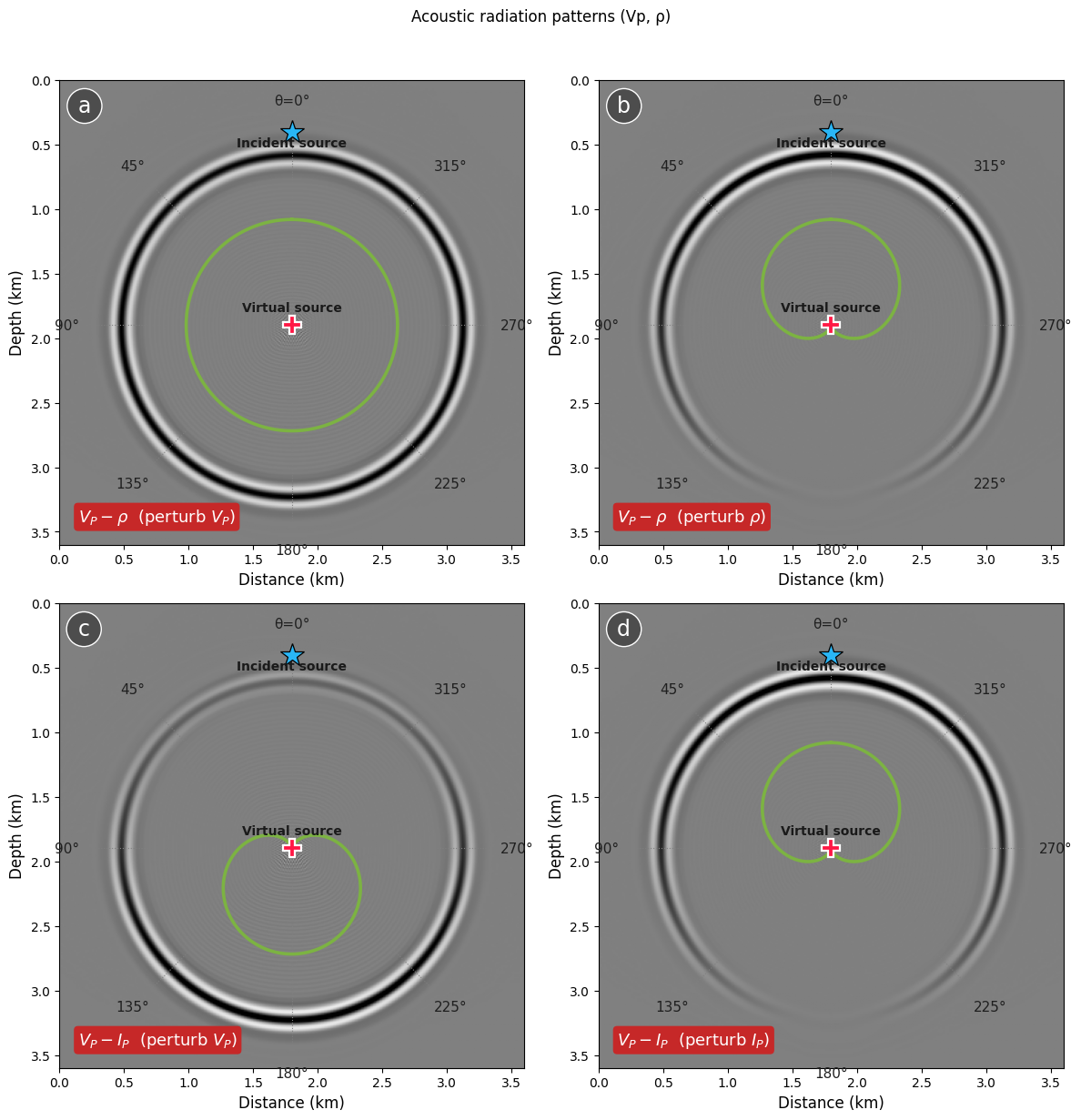
Sensitivity · Acoustic radiation
Scattered-wavefield snapshots of the partial-derivative virtual sources for the acoustic
(Vp, ρ)/(Vp, Iₚ)parameterizations — the angular sensitivity behind multiparameter trade-off. Reproduces Operto et al. (2013) Fig. 2. -
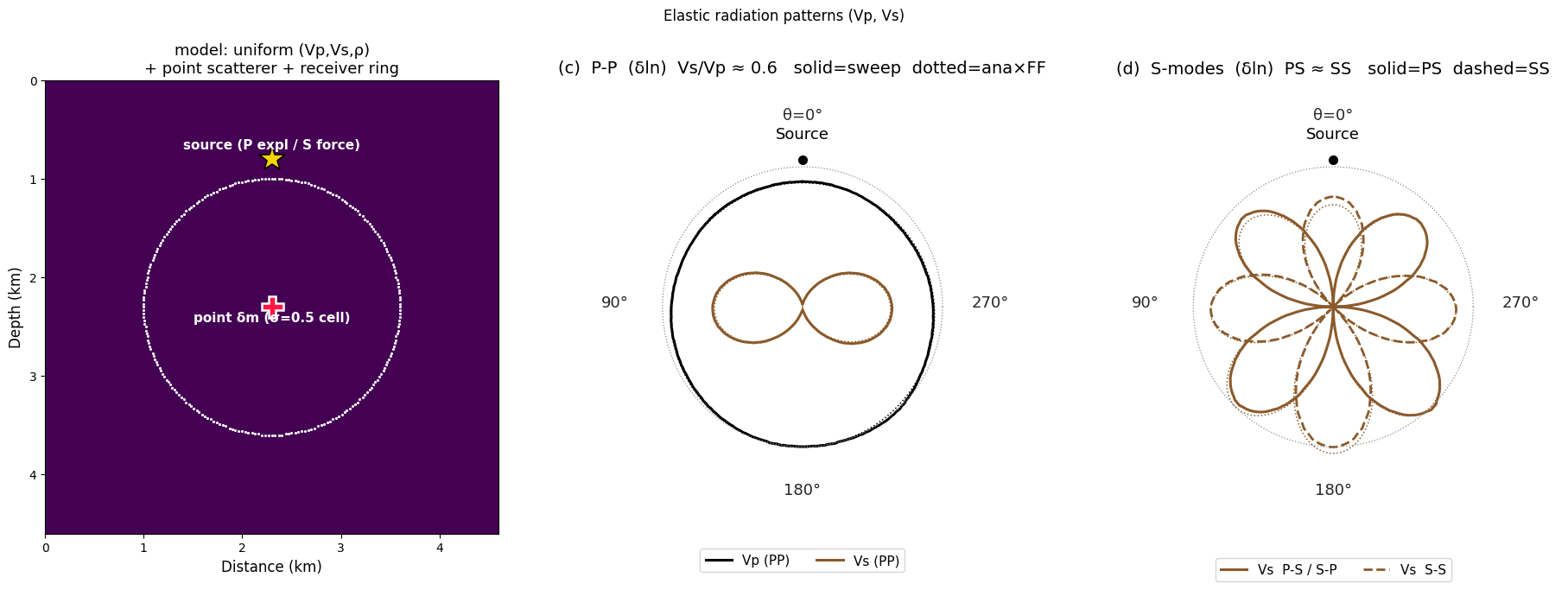
Sensitivity · Elastic radiation
Elastic
(Vp, Vs, ρ)P-P / P-S / S-S radiation patterns: the analytic Born kernel against sweep's Born-differenced numerics, the δln relative sizes (Vs/Vp ≈ 0.6), and scattered-wavefield snapshots. Cf. Operto Fig. 8(c,d) / Forgues & Lambaré.
Scripts
For workflows that don't fit a single notebook — e.g. multi-process multi-GPU FWI — see:
-
Multi-GPU DDP (
fwi_marmousi_dist.py) — Torchtorchrundriver that scales one-shot-per-rank across multiple GPUs and syncs gradients withtorch.distributed. -
Model-parallel FWI (
dd_fwi_marmousi_2d.py,dd_fwi_marmousi_elastic_2d.py,dd_fwi_overthrust_update.py) — the other axis: one model split across GPUs instead of one shot per GPU. Acoustic and elastic 2-D on Marmousi, plus a 3-D Overthrust model update. The two Marmousi scripts take--check <tag>to compare against an earlier run in--outdir(e.g. the same problem undivided,--px 1); the Overthrust script has no comparison mode.
Browse examples/
on GitHub for the full collection of runnable scripts.