Wavefield snapshots
task_type: wavefield dumps the pressure field at chosen time steps
(snapshot_times:) instead of only recording at receivers — the fastest way to
see a physics flag rather than reason about it. It writes output/record.npy,
output/snapshots.npy and output/snapshots.png. It runs on impl: eager,
because snapshot capture needs the wavefield returned to Python.
Reference: 18 s, snapshots at steps 400 / 900 / 1500 / 2400.
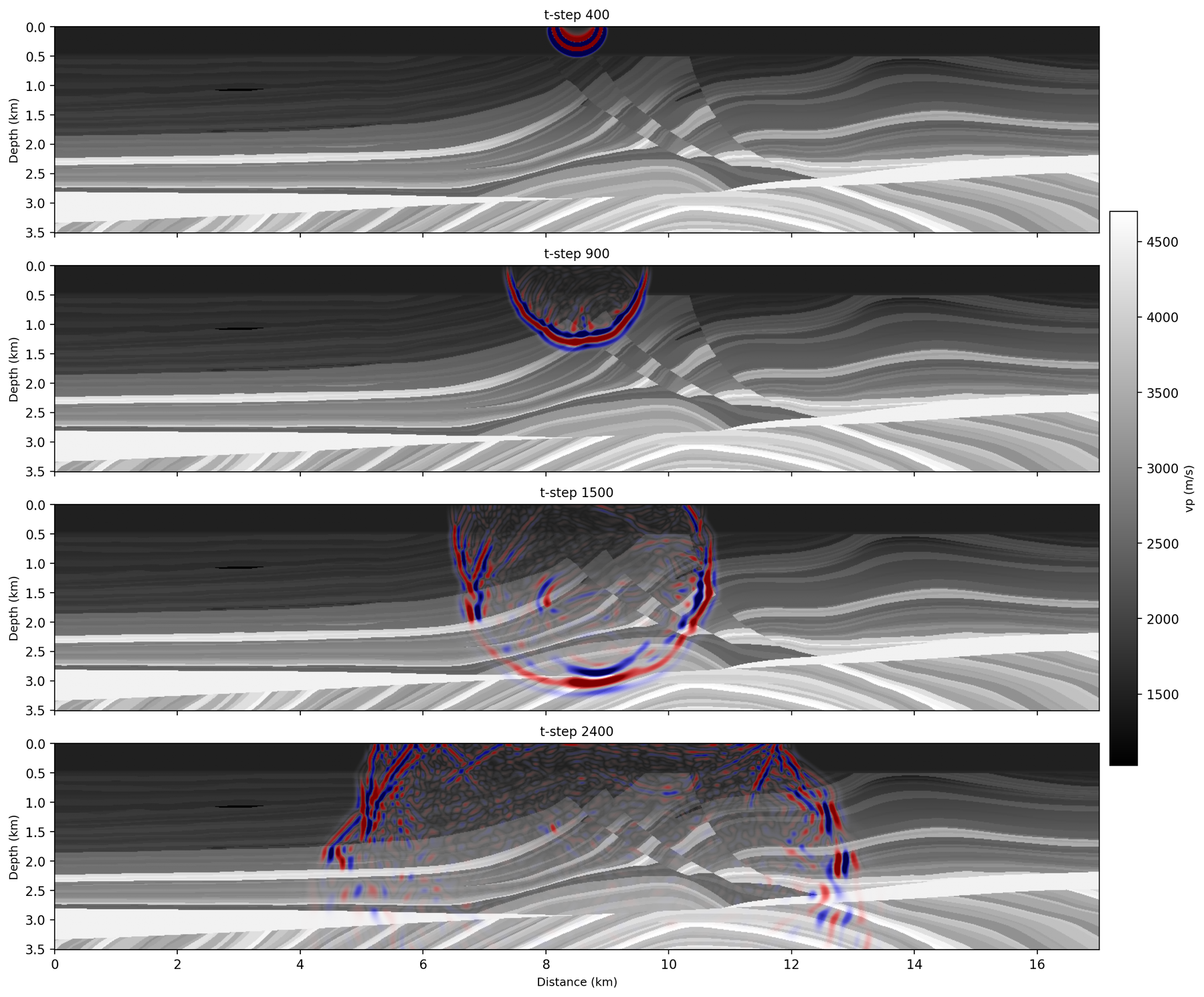
The velocity model is drawn underneath and the wavefield laid on top with a transparency taken from its own amplitude, so you can see what the wave is travelling through. Reading down: the source rings in the water layer, the front reaches the seabed, then the two near-vertical scattering trains at x ~ 7 km and x ~ 11 km line up with the fault zone, and by 2.4 s a strong surface multiple is bouncing along z = 0. Nothing reflects off the left and right edges, which is the CPML doing its job.
Try it: flip the free surface
With free_surface: true the snapshots show the downgoing wave, its
polarity-flipped ghost, and the surface multiples behind it. Set it to false
and re-run, and only the direct wavefront is left: