RTM and LSRTM
sweep-tasks run examples/synthetic/04_rtm_marmousi.yaml
sweep-tasks run examples/synthetic/05_lsrtm_marmousi.yaml
The FWI examples solve for velocity. These two hold it fixed at vp_smooth
and ask a different question: where are the reflectors?
| what it solves | passes | reference (RTX 6000 Ada, seed 0) | |
|---|---|---|---|
| 04 RTM | nothing — one adjoint pass | 1 | 164 s |
| 05 LSRTM | reflectivity, linear in the unknown | 20 epochs | 89 s, misfit 1.458e-2 → 1.374e-2 |
RTM cross-correlates the source wavefield with the back-propagated residual and stacks over shots. It is fast and it is not an inversion, so the image carries the acquisition footprint and the source signature. LSRTM iterates on that image until the demigrated data matches the observed scattered field — same physics, but deconvolved and better balanced. Neither touches the non-linearity that makes FWI hard, because the background velocity never moves.
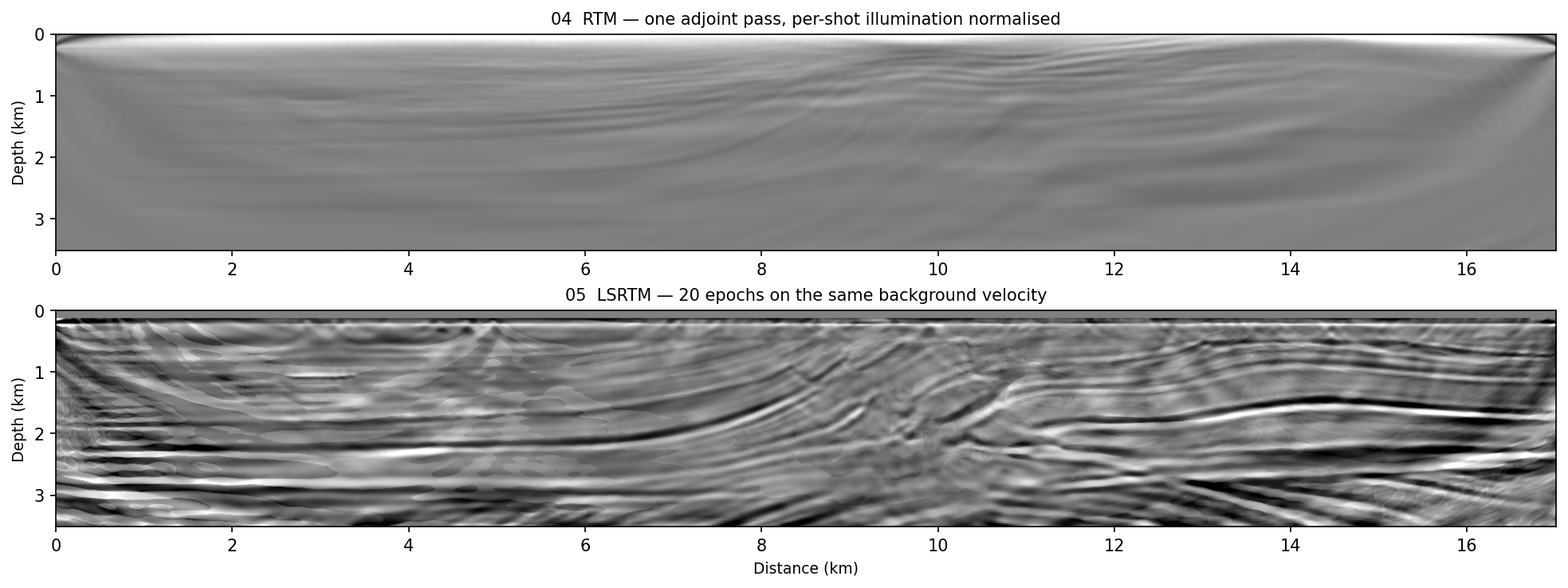
Both are plotted on the same signed grey scale. RTM gets the reflectors in one pass; LSRTM sharpens them and evens out the amplitudes, which is what inverting rather than migrating buys.
04 — what the RTM output directory holds
04 writes its image three ways — raw (rtm_image.npy),
illumination-normalised and per-shot normalised — plus a depth-tapered
Laplacian post-filter applied to each, with a PNG for each, so you can see what
each knob does rather than take it on trust. That is why the output directory
has twenty-odd files for one run.
05 — LSRTM
equation: AcousticLSRTM is the Born-scattering variant of the acoustic
equation: the background velocity stays fixed and the unknown is reflectivity.
The runner builds the scattered data itself as forward(true) − forward(bg),
so obs is purely the reflected wavefield. Reflectivity is O(0.1), not O(1000)
like vp, which is why optimizer.lr is 0.02 and reflectivity_bounds clips it
to ±0.3. It writes output/reflectivity.npy, loss.npy + loss.png, and a
reflectivity snapshot every show_every epochs under output/epochs/.
The LSRTM misfit is not monotone, and that is expected rather than a bug: epochs 0 / 9 / 19 read 1.458e-2 / 1.393e-2 / 1.505e-2 before settling at 1.374e-2. The shot batch is redrawn every step, so consecutive epochs are measured on different data.