FWI, single-scale
FWI from vp_smooth, the low-pass-filtered true model. It keeps the right
depth trend, so a single broadband band converges without cycle-skipping.
Read this one first among the inversions: it shows the FWI task shape,
obs.synthetic_from (the observed data are synthesised from vp_true on the
fly, with the same grid, geometry and wavelet as 01), the
boundary-saving adjoint and the per-epoch QC — without the multiscale machinery
on top.
Reference (RTX 6000 Ada, seed 0), 200 epochs, 29.6 min:
| misfit | 1.592e-02 → 1.564e-04 (min, epoch 115) → 2.575e-04 |
| RMSE vs true | 357.3 (init) → 270.6 |
perturbation correlation r |
0.700 |
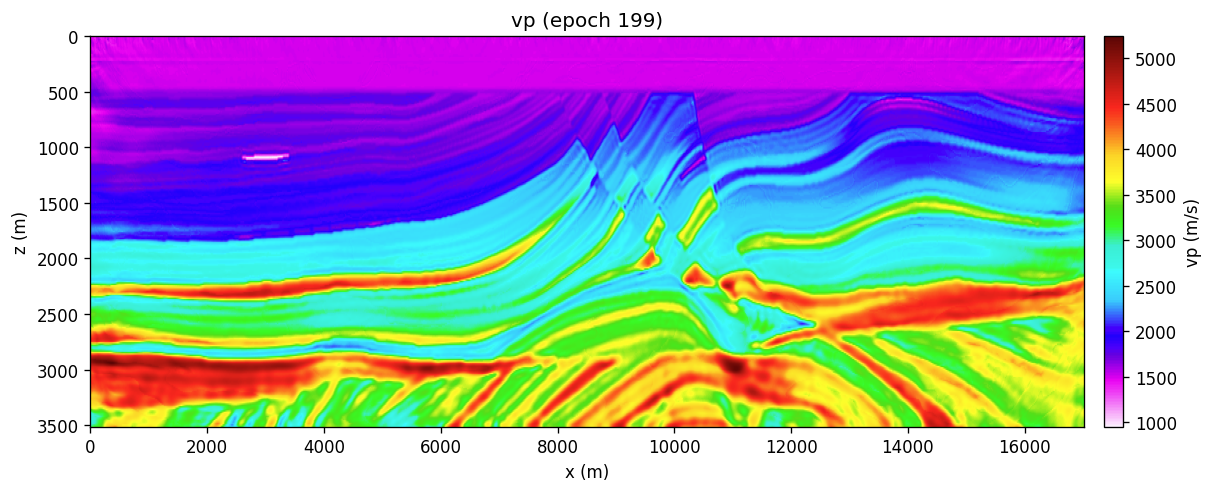
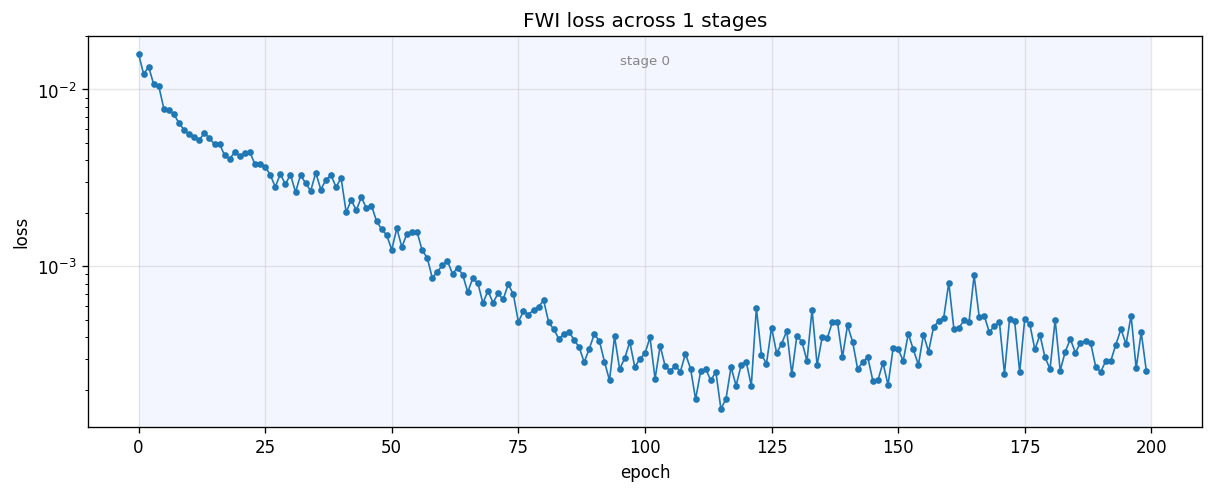
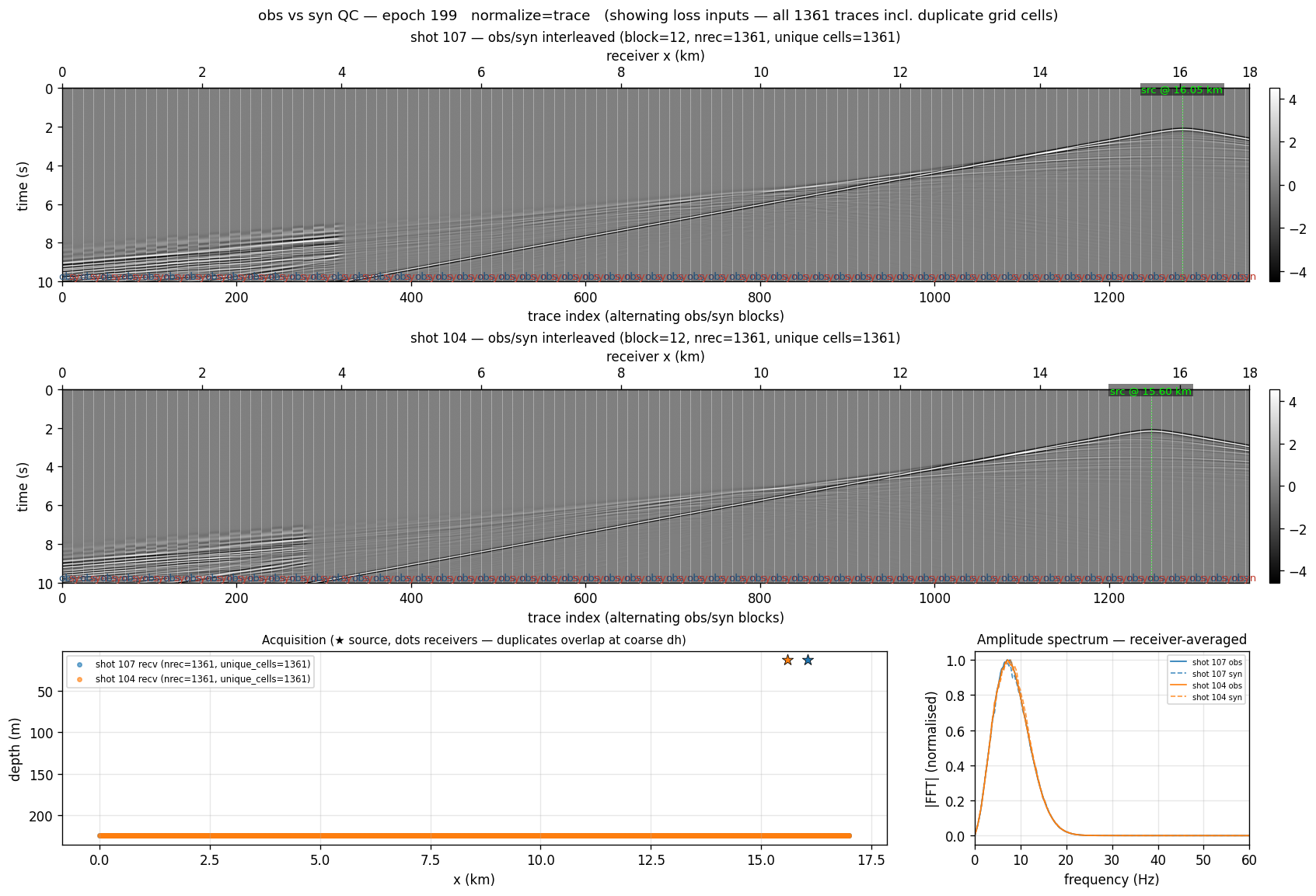
The runner's obs/syn QC panel — interleaved gathers, the acquisition map, and a receiver-averaged amplitude spectrum where obs and syn sit on top of each other:
Where the 30 minutes go
200 epochs × 16 shots is 3200 shot gradients, each a 10 s record at dt = 1 ms
(10,000 steps). With strategy: boundary the backward pass re-propagates the
forward from the saved boundary, so each gradient is about three wavefield
sweeps. Run it on several GPUs to split the shots:
batchsize is a fraction, not a count
It is how many shots are drawn at random per optimizer step, so what matters
is batchsize / nshots. Keep it near ~15 %. Measured here: 114 shots with
batchsize: 8 (7 %) gives RMSE 297, and batchsize: 16 (14 %) gives 271 —
denser shots only pay off if the batch grows with them.