Quickstart
One command, nothing to download
The models come from sweep.datasets, so the example YAMLs are self-contained —
no .npy to prepare, no env vars, no SEG-Y:
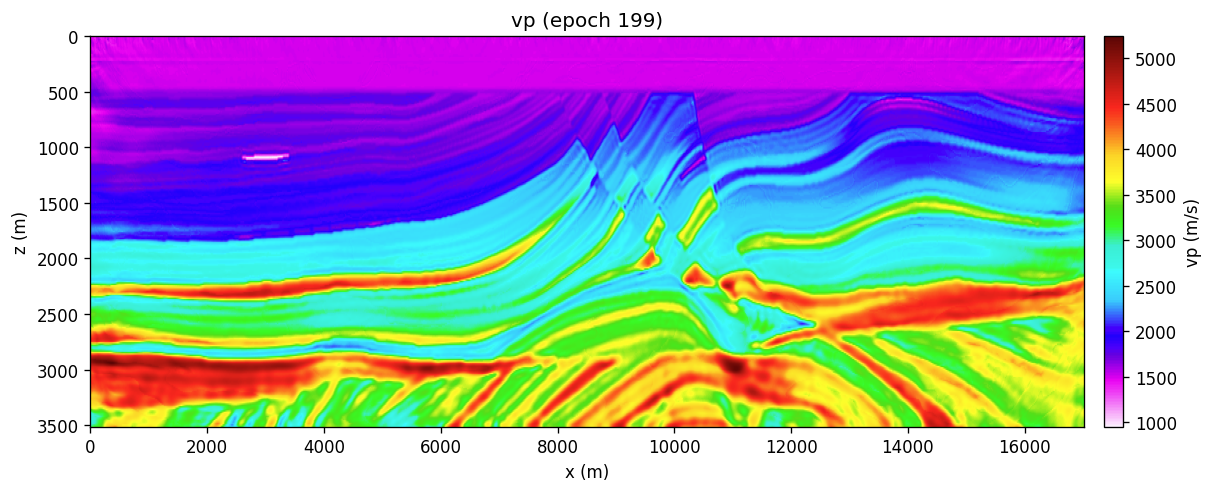
That is a full FWI on Marmousi-II: the observed data are synthesised from the
true model on the fly, and 200 epochs from a smoothed start take about 30 min
on one RTX 6000 Ada. The result lands in
examples/synthetic/sweep_runs/fwi_marmousi_single/output/inverted_vp.npy:
To see the data rather than invert it, run the forward on its own:
The Examples cover every task type the same way, with reference numbers to check your run against.
A task YAML by hand
The same FWI as above, cut to 30 epochs and written out with only the keys it needs:
task_type: fwi
task_id: my_fwi
seed: 0
grid: {dh: 12.5}
time: {dt: 0.001, nt: 10000}
wavelet: {kind: ricker, fm: 8.0, delay: 2.0}
geometry:
  kind: line
  sources:   {step: 12, depth: 1}
  receivers: {step: 1,  depth: 18}
physics: {equation: Acoustic}
backend:
  impl: c
  cuda_options: {memory: {strategy: boundary, boundary: {storage: gpu}}}
init_model: {name: vp, dataset: "marmousi:2d-demo", preset: vp_smooth}
obs:
  synthetic_from: {name: vp, dataset: "marmousi:2d-demo", preset: vp_true}
loss: {kind: mse}
optimizer: {kind: adam, lr: 25.0}
epochs: 30
batchsize: 16
The cuda_options line spells out the default for impl: c, boundary saving:
the adjoint keeps only the PML slab and reconstructs the rest exactly.
strategy: full would store every time step instead, about 276 GiB on this
grid (see Backends and memory).
Run it from the shell, or drive it from Python:
from sweep_tasks import TaskRunner, load_task

spec = load_task("task.yaml")
result = TaskRunner().run(spec)
print(result.status.state, result.task_dir)
Prefer to start from an annotated template?