FWI, multiscale
Same grid, geometry and wavelet as 01 and
02. What changes is the start: a 1-D ramp with no lateral
structure whatsoever, so nothing about the answer leaks in through the model. A
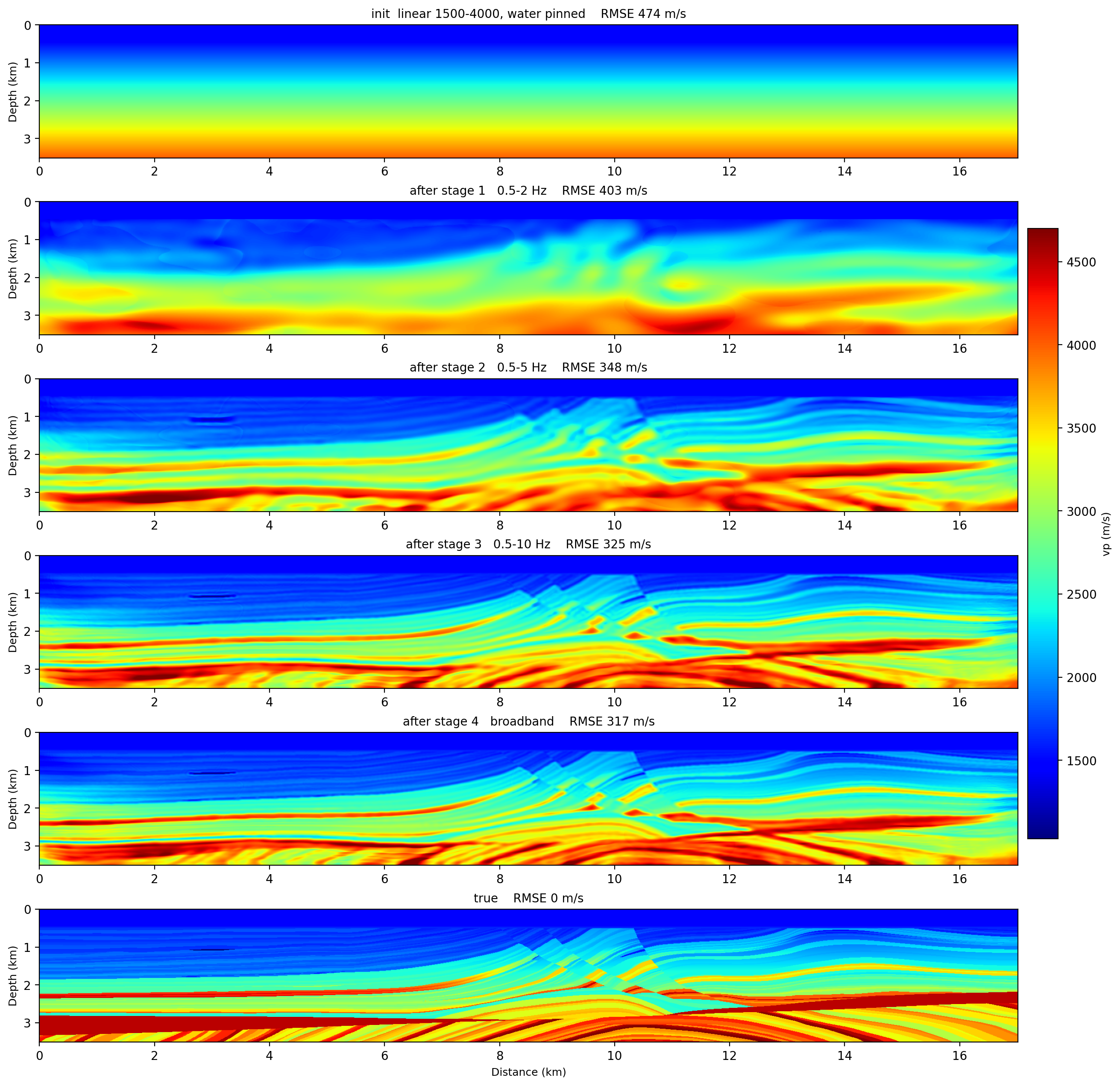
single broadband band cycle-skips from there; the four-stage stages: ladder
(2 → 5 → 10 Hz → broadband, 50 epochs each, each with its own bandpass and
lr_scale) is what makes it work.
Reference (RTX 6000 Ada, seed 0), 4 × 50 epochs, 11.5 min:
| after | RMSE vs true |
|---|---|
| init (1-D ramp 1500→4000, water pinned) | 473.7 |
| stage 1 — 0.5–2 Hz | 402.6 |
| stage 2 — 0.5–5 Hz | 347.6 |
| stage 3 — 0.5–10 Hz | 325.3 |
| stage 4 — broadband | 317.3 |
perturbation correlation r = 0.752; low-wavenumber RMSE (both smoothed by
σ = 8 cells) 184.9, a 42.5 % improvement on the starting model.
Why those rungs
The ladder is not a magic sequence. A stage cycle-skips where the two-way traveltime error exceeds half a period, so the next rung must satisfy
Measured on this setup, the 1-D start is −160 ms off at 2 km depth in the flat-layered left half of the model. That forces the first rung below 3.1 Hz — 2 Hz here. One 2 Hz stage pulls the error down to about −50 ms, which clears 5 Hz (100 ms half-period), and so on up. Jumping straight from the 1-D start to 5 Hz reproducibly wrecks the left half, while the right half — which starts only +65 ms off — converges fine either way.
Two consequences worth internalising:
- RMSE against the true model is a poor progress metric here. It is
dominated by thin-layer amplitudes FWI cannot resolve. Traveltime error and
the perturbation correlation
rtrack what the inversion is actually doing; RMSE rose through the stages in several configurations that were visibly improving the background. - A single 1-D gradient cannot suit both halves of Marmousi. The left half
wants a slower start, the right half a faster one, and
|Δt_left| +
  |Δt_right|
at 2 km is invariant (255 ms) whatevervmaxyou choose. Raising it only moves error from one half to the other.
Why the wavelet has 2 s of lead-in
wavelet.delay: 2.0 is sized by stage 1. Low-passing an 8 Hz Ricker to
0.5–2 Hz stretches its left lobe back about 2 s; with only 1 s of lead-in the
lobe is clipped at t = 0 and the step radiates a broadband floor (~1e-3) across
the whole spectrum, so the "2 Hz" stage is not actually band-limited. 2 s
drops that floor 5×.