HPC
Memory strategies, compressed boundary storage, one shot per GPU, and one model split across GPUs.
-
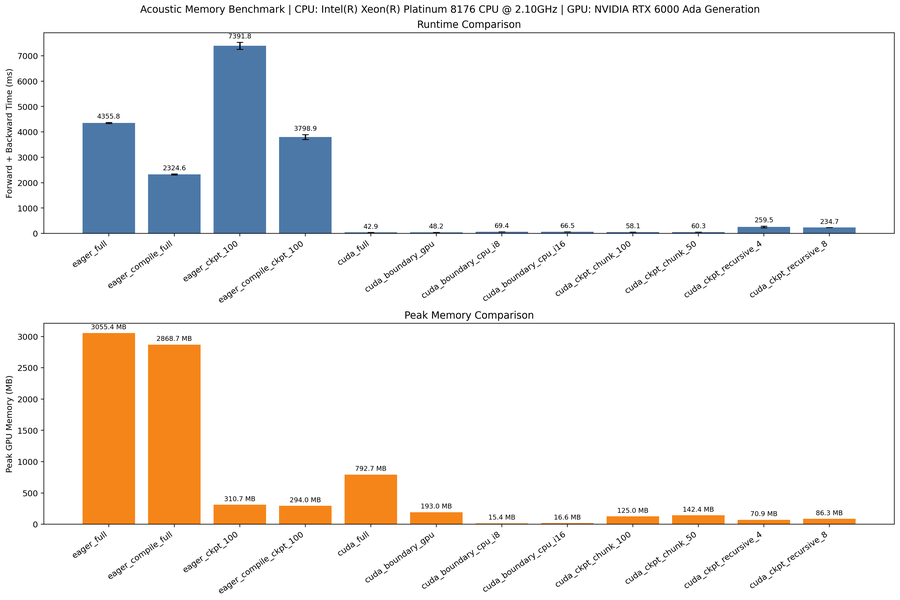
Memory · strategies
Same forward + backward step run under every memory strategy (eager full / chunk-ckpt / boundary-saving on gpu × dtype vs. c full / boundary-saving on
{gpu, cpu, disk}× dtype / chunk-ckpt / recursive-ckpt) with side-by-side peak-memory and wallclock charts. -
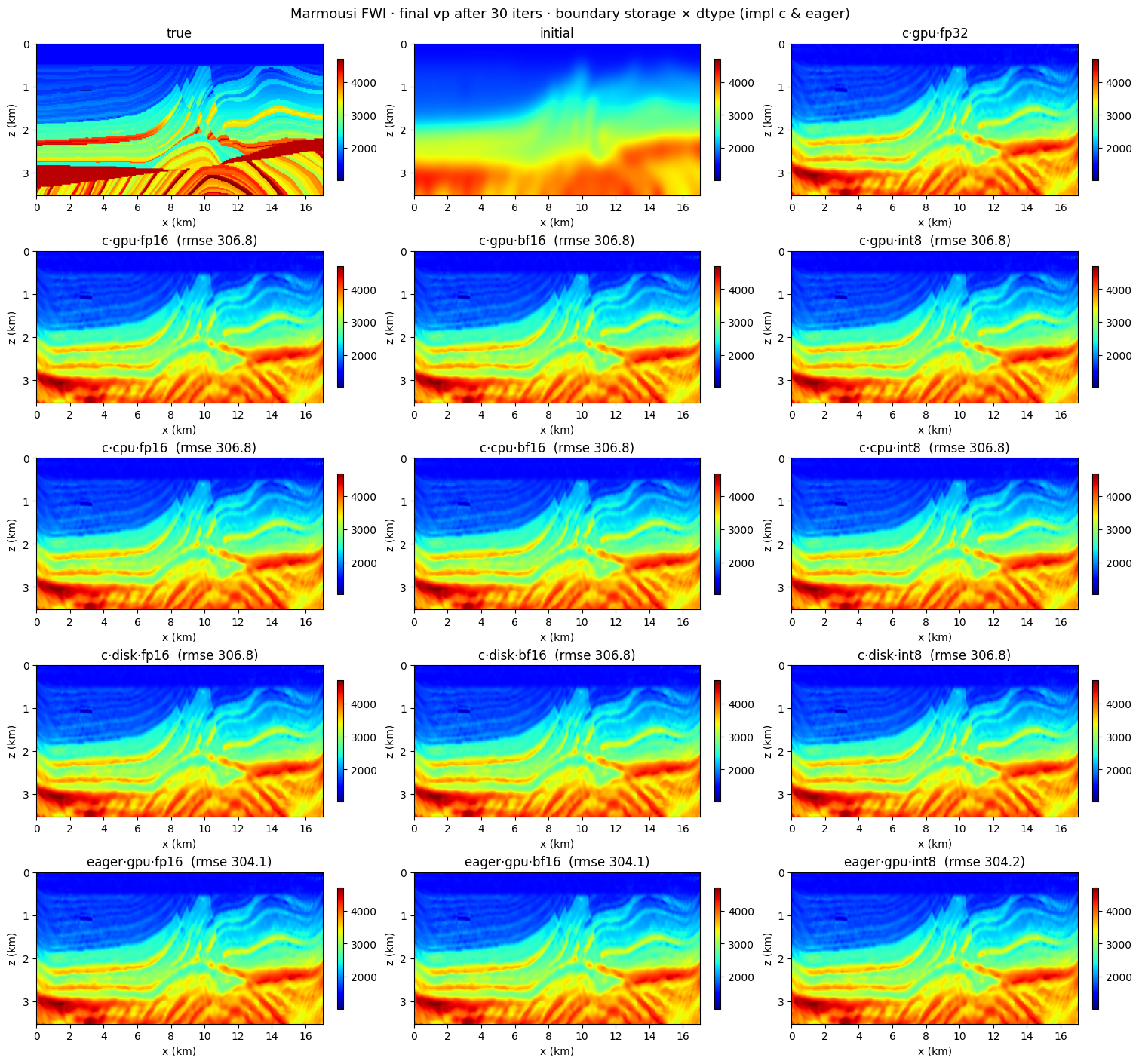
FWI · boundary compression
storage_dtype(fp16/bf16/int8) shrinks the saved boundary wavefield while compute stays FP32. Marmousi FWI across the full{gpu, cpu, disk} × dtypematrix on the compiled path, plus gpu × dtype on eager — identical convergence, plus a runtime GPU-memory breakdown. -
Multi-GPU · DDP vs 1 GPU
torchrun --nproc_per_node=Ndriver that shards shots across GPUs and syncs gradients viatorch.distributed, timed against a single-GPU baseline on a two-layer toy model (the saved run: 3.53× on 4 GPUs). -
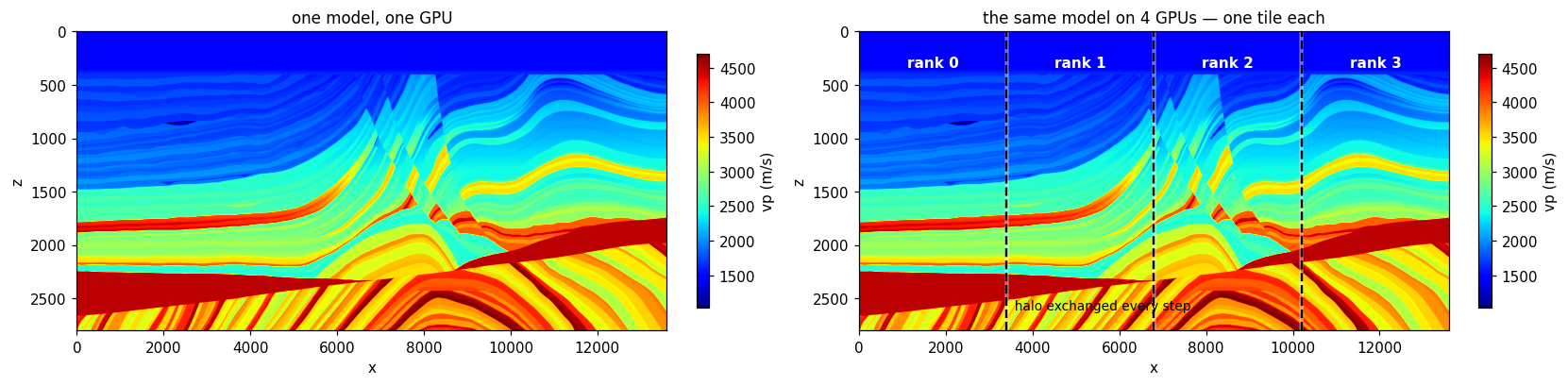
HPC · Domain decomposition
One model, several GPUs:
ModelParallelslices it into tiles and exchanges a halo every step, so a single shot is solved cooperatively rather than replicated. Gradients are bit-identical to the single-domain run — the notebook checks that, tile by tile. -
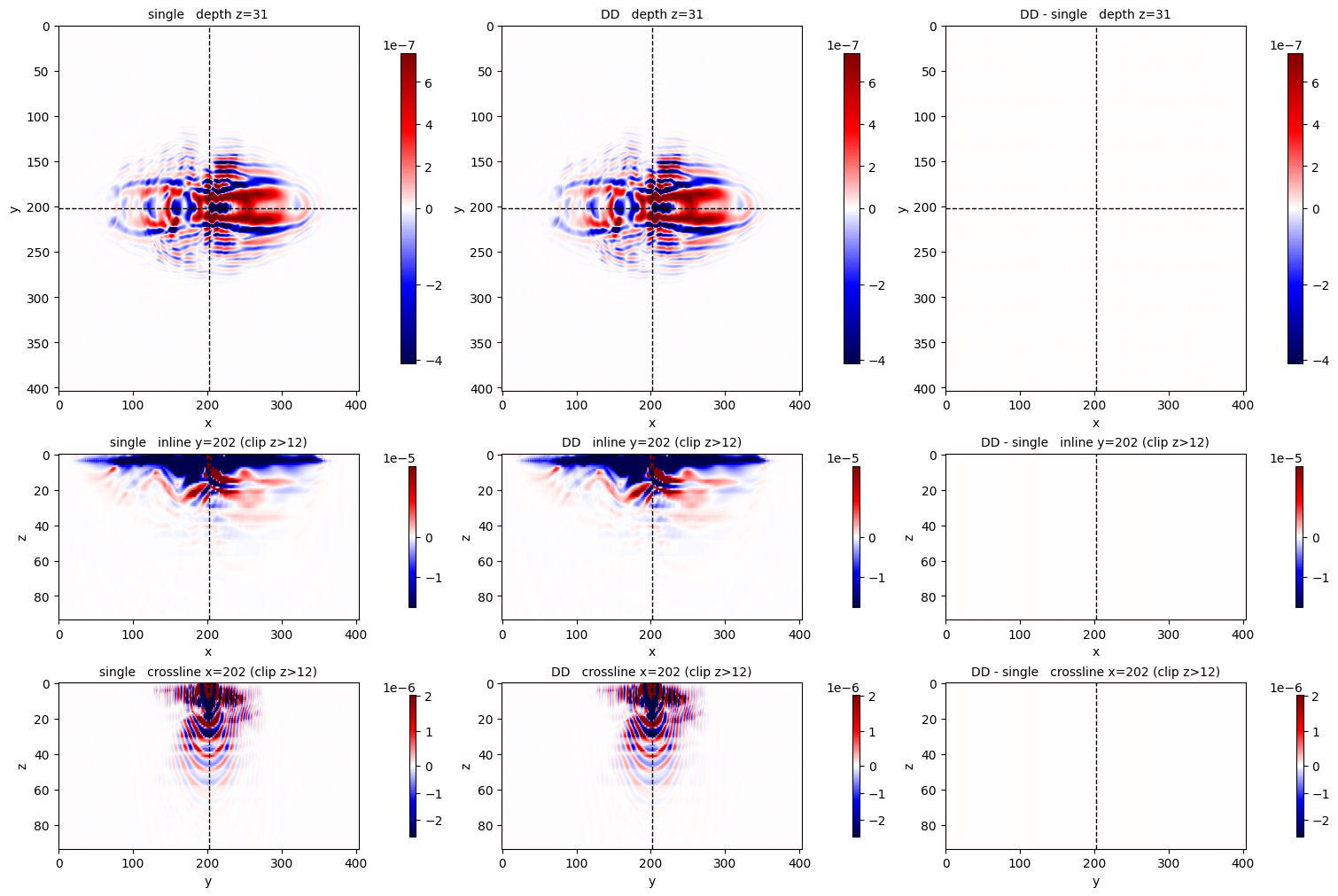
HPC · DD on Overthrust 3-D
The same split on a real 3-D benchmark, 2 × 2 tiles across four GPUs. The gradient is sliced three ways straight across the cut planes, where a halo bug would show as a stripe — and compared against the single-GPU answer.